
explainer
Blood Sugar Units Explained: mg/dL, mmol/L, HbA1c and eAG
By Uttam Regmi · Published 2026-08-01 · Updated 2026-08-23 · 7 min read · Fact-checked, sources cited
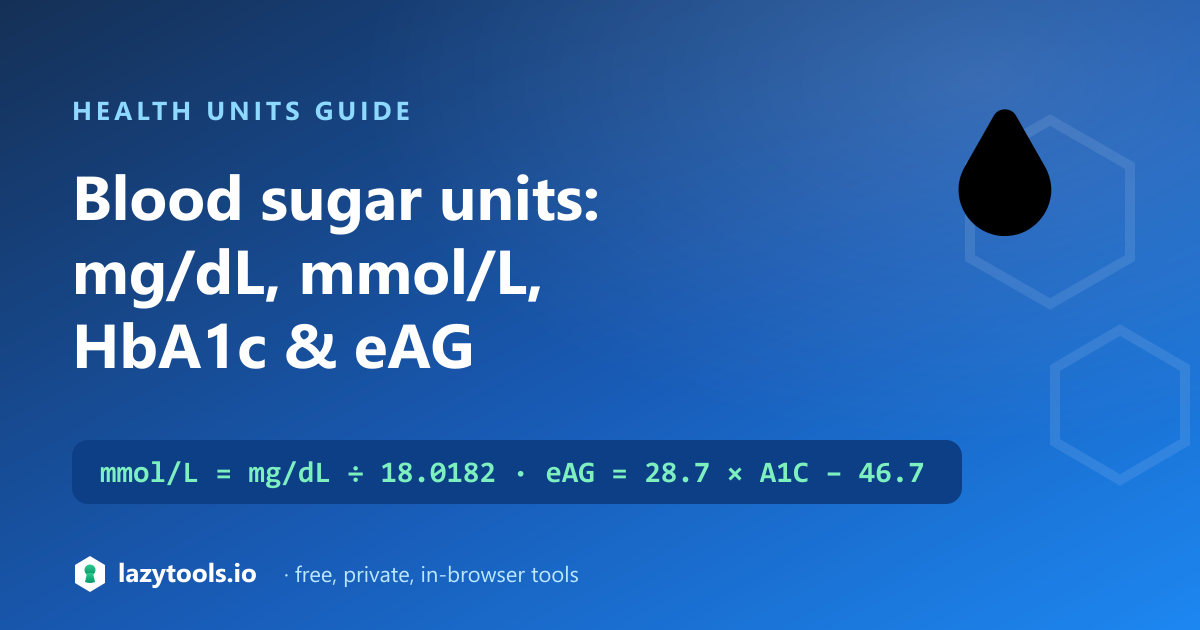
mg/dL and mmol/L are the same blood glucose written on two scales: divide mg/dL by 18.0182 to get mmol/L, or multiply mmol/L by 18.0182 to go back. HbA1c, a longer-term measure, has its own pair of scales (percent and mmol/mol) plus an “estimated average glucose” that maps it back onto the familiar meter reading. This guide connects all four so a number in one system stops being a mystery. Convert instantly with the Blood Sugar Converter and the HbA1c Converter, both run locally in your browser.
These tools and this article explain unit conversions only. They are not medical advice and can’t tell you whether a value is high, low or normal for you, that depends on your circumstances and is a question for a healthcare professional.
Glucose: mg/dL ↔ mmol/L
A glucose reading is a snapshot, your blood sugar right now, from a meter or lab. Two conventions report it:
- mg/dL (milligrams per decilitre), a measure of mass per volume. Used in the US, Germany, France and Japan.
- mmol/L (millimoles per litre), a measure of number of molecules per volume. Used in the UK, Canada, Australia and most of the world.
They differ by a single fixed factor:
mmol/L = mg/dL ÷ 18.0182 · mg/dL = mmol/L × 18.0182
That 18.0182 isn’t arbitrary. It comes from glucose’s molar mass, roughly 180 g/mol, combined with the decilitre-to-litre step (a factor of 10). Two unit differences collapse into one number, so the conversion is a clean, reversible constant with no rounding baked in. Some references round it to a flat 18, which shifts a reading by well under 1%, fine for a mental estimate, but the tools use the full 18.0182 so a round-trip lands back where it started.
Worked example. A UK lab reports a fasting glucose of 5.4 mmol/L. Multiply by 18.0182 → 97 mg/dL, squarely in the normal fasting range on the US scale. Going the other way, a US reading of 126 mg/dL ÷ 18.0182 = 7.0 mmol/L, the number most guidelines cite as the fasting threshold for diabetes. Same blood, two vocabularies.
| mg/dL | mmol/L |
|---|---|
| 70 | 3.9 |
| 100 | 5.6 |
| 126 | 7.0 |
| 140 | 7.8 |
| 180 | 10.0 |
| 200 | 11.1 |
HbA1c: a different measurement entirely
HbA1c isn’t a snapshot. It measures the fraction of your haemoglobin that has become glycated, bonded with glucose, which builds up over the ~2-3 month lifespan of red blood cells. So it reflects your average glucose over months, not this morning’s reading. And like glucose, it’s reported on two scales:
- NGSP / DCCT (%), the older percentage scale, aligned to the Diabetes Control and Complications Trial. A value like “7%”.
- IFCC (mmol/mol), the newer international standard: millimoles of HbA1c per mole of total haemoglobin. A value like “53 mmol/mol”.
The two are linked by the IFCC, NGSP master equation:
IFCC (mmol/mol) = 10.929 × (NGSP% − 2.15)
So 7% → 53 mmol/mol, and 8% → 64 mmol/mol. Since around 2011 many labs report both side by side, which is exactly when people start needing to convert.
eAG: putting HbA1c back on the meter scale
An HbA1c percentage is hard to picture next to your daily readings. The estimated average glucose (eAG) fixes that. From the ADAG study (Nathan et al., Diabetes Care, 2008), which correlated HbA1c with continuous glucose monitoring:
eAG (mg/dL) = 28.7 × HbA1c% − 46.7
Then divide by 18.0182 for mmol/L. So an HbA1c of 7% ≈ 154 mg/dL (8.6 mmol/L) average glucose.
| HbA1c % | IFCC mmol/mol | eAG mg/dL | eAG mmol/L |
|---|---|---|---|
| 6.0 | 42 | 126 | 7.0 |
| 6.5 | 48 | 140 | 7.8 |
| 7.0 | 53 | 154 | 8.6 |
| 7.5 | 58 | 169 | 9.4 |
| 8.0 | 64 | 183 | 10.2 |
eAG is a population average: two people with the same HbA1c can have somewhat different true average glucose because red-cell turnover varies. Treat it as a helpful translation, not a personal guarantee.
Reference ranges for context
Conversions only tell you the number, not what it signifies. For orientation, the table below shows the broad categories the American Diabetes Association, Diagnosis and Classification of Diabetes uses, on every scale at once. These are general diagnostic thresholds, a clinician interprets them alongside your history, symptoms and repeat testing, and some conditions (pregnancy, anaemia, certain haemoglobin variants) shift how the numbers behave.
| Category | Fasting glucose (mg/dL) | Fasting glucose (mmol/L) | HbA1c (%) | HbA1c (mmol/mol) |
|---|---|---|---|---|
| Normal | below 100 | below 5.6 | below 5.7 | below 39 |
| Prediabetes | 100-125 | 5.6-6.9 | 5.7-6.4 | 39-46 |
| Diabetes range | 126 or above | 7.0 or above | 6.5 or above | 48 or above |
The point of lining the scales up like this is that a single result, say 6.5%, is simultaneously 48 mmol/mol on the IFCC scale and an eAG of about 140 mg/dL (7.8 mmol/L). None of those are different findings; they’re the same fact in four dialects.
Where the conversions trip people up
A few recurring snags are worth naming:
- Mixing up the two “mmol” units. Glucose is reported in mmol/L; HbA1c on the IFCC scale is mmol/mol. They look similar but measure completely different things, never convert one into the other directly.
- Applying 18.0182 to HbA1c. The glucose factor only bridges mg/dL and mmol/L. To move an HbA1c percentage onto a glucose scale you must go through eAG first, then apply 18.0182 if you want mmol/L.
- Over-reading small differences. Because HbA1c reflects a months-long average, a change from 6.9% to 7.0% is within normal measurement noise, not a meaningful jump. eAG inherits that same fuzziness.
- Rounding drift. Rounding mg/dL to a whole number before converting, then rounding again, can shift the last digit. Converting from the raw value in one step, which the calculators do, avoids it.
Putting it together
- A glucose reading is now; convert mg/dL ↔ mmol/L with ÷ or × 18.0182.
- HbA1c is a 2-3 month average; convert % ↔ mmol/mol with IFCC = 10.929 × (% − 2.15).
- eAG bridges the two, turning an HbA1c into an average meter reading with 28.7 × % − 46.7.
Do the arithmetic instantly and privately with the Blood Sugar Converter and HbA1c Converter, and remember these convert units, they don’t interpret them. For what your numbers mean, talk to your clinician.
Frequently asked questions
How do I convert mg/dL to mmol/L?
Divide the mg/dL value by 18.0182. For example, 100 mg/dL ÷ 18.0182 = 5.6 mmol/L, and 140 mg/dL ÷ 18.0182 = 7.8 mmol/L. To go the other way, multiply mmol/L by 18.0182: 7 mmol/L × 18.0182 = 126 mg/dL. The factor is the molar mass of glucose (180.156 g/mol) divided by 10.
Why is the conversion factor 18.0182?
Because mg/dL and mmol/L differ in two ways at once. mmol/L counts molecules (millimoles) while mg/dL counts mass (milligrams), and the two units use different volumes (litre vs decilitre). Dividing glucose's molar mass, 180.156 g/mol, by 10 to account for the dL-to-L step gives 18.0182, the single number that bridges both differences.
Which countries use mg/dL and which use mmol/L?
The United States, Germany, France, Japan and a few others report glucose in mg/dL. The UK, Ireland, Canada, Australia, New Zealand and most of the rest of the world use mmol/L. This is purely a difference in convention, the underlying blood glucose is identical, which is why an exact conversion factor exists.
What's the difference between HbA1c % and mmol/mol?
They measure the same glycated haemoglobin on two scales. The older NGSP/DCCT scale reports a percentage (aligned to the landmark diabetes trials), while the newer IFCC scale reports millimoles of HbA1c per mole of haemoglobin. They're linked by IFCC = 10.929 × (NGSP% − 2.15), so 7% equals 53 mmol/mol. Many labs now print both.
What is estimated average glucose (eAG)?
eAG expresses an HbA1c result on the same scale as a day-to-day glucose meter. It comes from the ADAG study (Nathan et al., Diabetes Care 2008), which found eAG (mg/dL) = 28.7 × HbA1c% − 46.7. So an HbA1c of 7% corresponds to an average glucose of about 154 mg/dL, or 8.6 mmol/L. It's a population average, not an exact personal reading.
Is HbA1c the same as a blood sugar reading?
No. A glucose reading (mg/dL or mmol/L) is a snapshot of your blood sugar at one moment. HbA1c reflects your average glucose over roughly the previous 2-3 months, because it measures how much haemoglobin has become glycated over the lifespan of red blood cells. eAG is the bridge that puts HbA1c back onto the familiar glucose scale.
Is my data private when I use these converters?
Yes. The LazyTools blood sugar and HbA1c converters run entirely in your browser, nothing you type is uploaded or stored. These tools convert between units and are not medical advice or a diagnosis; what a given number means for you is a conversation to have with your clinician.