
explainer
Morse, NATO, Binary and Classic Ciphers: Codes You Can Actually Read
By Uttam Regmi · Published 2026-07-06 · Updated 2026-07-06 · 6 min read · Fact-checked, sources cited
Morse code, the NATO phonetic alphabet and binary are encodings, reversible by anyone, built for communication, not secrecy, while the Caesar, ROT13 and Vigenère ciphers scramble text with a key but are all easily broken; none of them is encryption. You can encode, decode and play with all of them in the Codes & Ciphers tools, starting with the Morse code translator.
Three different things people call “codes”
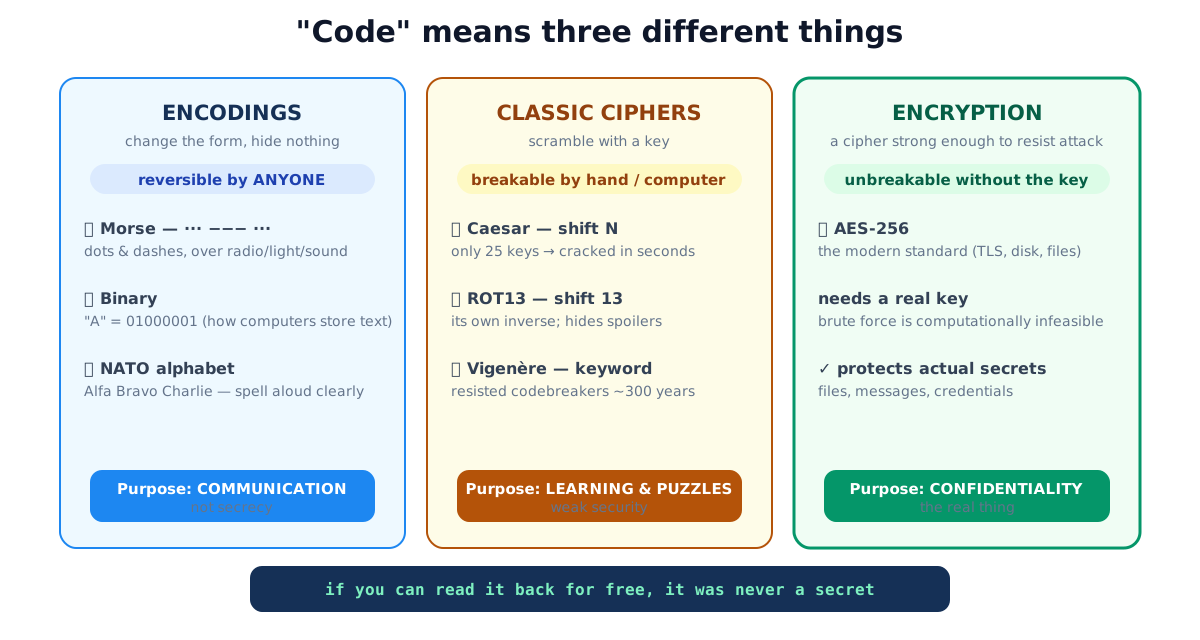
The word “code” gets used for three genuinely different ideas, and telling them apart is the key to knowing what each tool is for.
Encodings change the form of a message without hiding it. Morse code turns letters into dots and dashes so they can travel over sound, light or a telegraph wire. Binary turns them into the 0s and 1s a computer stores. The NATO phonetic alphabet turns them into spoken words. All are fully reversible by anyone who knows the scheme, that’s the point. They solve a channel problem, not a secrecy one.
Classic ciphers scramble a message with a key so it looks unreadable. The Caesar and Vigenère ciphers are the famous examples. They provide real obfuscation but, by modern standards, weak security, all are breakable by hand or in an instant by computer.
Encryption is a cipher made strong enough that it can’t be broken without the key, even with enormous computing power. AES, the algorithm behind the file encryption in Privacy & Security, is the modern standard. This is the only one of the three you should trust with a real secret.
The encodings
Morse code represents each character as short and long signals, dots and dashes. A dash is three times the length of a dot; letters are separated by a medium gap and
words by a long one. It’s still used by aviation and marine navigation beacons and by amateur radio
operators, because it cuts through noise at very low power. The classic SOS is ··· −−− ···,
chosen for being simple and unmistakable. (Our translator can even play the tones so you can learn the
rhythm.)
Binary is how computers store text: each character becomes its
UTF-8 byte(s), written as 8 bits each. “A” is 01000001. It’s an encoding, not a cipher, anyone can
read it straight back.
The NATO phonetic alphabet, Alfa, Bravo, Charlie through Zulu, solves a spoken-channel problem: letters like B, P, T and V sound alike over a crackly phone line, so replacing each with a distinct word removes the ambiguity. (The odd spellings “Alfa” and “Juliett” are deliberate, so speakers of any language pronounce them right.)
Braille encodes letters as patterns of raised dots in a six-dot cell, so text can be read by touch. Our translator produces Grade 1 (uncontracted) Unicode Braille with the standard capital and number indicators, and reads it back, an encoding for a different sense, not a different channel.
The ciphers
The Caesar cipher shifts every letter a fixed number of places, shift 3 turns A into D. With only 25 possible shifts it offers no security: try them all and one is readable. That’s exactly what the tool’s “crack it” panel does. ROT13 is the special case of shift 13, which is its own inverse (apply it twice and you’re back to the start), used to hide spoilers in plain sight, not to protect anything.
The Vigenère cipher is the clever step up: a keyword sets a different shift for each letter, so the same plaintext letter encrypts differently depending on where it sits. That defeats the simple letter-frequency analysis that breaks a Caesar cipher instantly, and it earned the nickname le chiffre indéchiffrable, “the indecipherable cipher.” It held out for roughly 300 years, until Friedrich Kasiski published a method in 1863 (anticipated by Charles Babbage) to find the key length and unravel it. Still not secure today, but a beautiful lesson in how polyalphabetic ciphers work.
A few more classic ciphers worth knowing, all substitution ciphers, all keyless or near-keyless:
- Atbash simply reverses the alphabet (A↔Z, B↔Y). Ancient, Hebrew in origin, and, like ROT13, its own inverse.
- A1Z26 numbers the alphabet (A=1 … Z=26), turning “HI” into “8-9”. It’s the single most common code in escape rooms and geocaching, often as the first layer of a multi-step puzzle.
- Bacon’s cipher encodes each letter as five symbols of two kinds (AAAAA, AAAAB…). Its genius was steganography: the two symbols could be hidden as two fonts in an innocent-looking text, concealing that a message existed at all.
Then there’s a different family entirely. Every cipher above is a substitution. It replaces letters. The rail fence cipher is a transposition cipher: it keeps the letters but scrambles their order, writing the text in a zigzag across a number of “rails” and reading each rail off in turn. The giveaway is that the ciphertext contains exactly the same letters as the plaintext, and with only a handful of rail counts, it’s quickly cracked.
Finally, ROT47 extends the ROT13 idea across all printable ASCII, so digits and symbols get scrambled too, handy in programming circles where ROT13 would leave numbers readable.
When to use which
| You want to… | Use | Secret? |
|---|---|---|
| Send letters over radio/light/sound | Morse | No |
| Spell a word clearly aloud | NATO alphabet | No |
| See text as a computer stores it | Binary | No |
| Read text by touch | Braille | No |
| A puzzle / escape-room number code | A1Z26 | No |
| Learn substitution ciphers | Caesar, Atbash, Vigenère | Weakly |
| Learn transposition | Rail fence | Weakly |
| Hide a spoiler in plain sight | ROT13, ROT47 | No |
| Hide that a message even exists | Bacon’s cipher | Weakly |
| Actually protect a file or message | AES encryption | Yes |
Common mistakes
- Treating an encoding as secret, Base64, binary and Morse hide nothing; anyone decodes them.
- Trusting a classic cipher with real data, Caesar falls in seconds, Vigenère in minutes by computer.
- Confusing ROT13 with encryption, it’s a fixed, keyless rotation, purely for obscuring spoilers.
- Forgetting Morse spacing, the gaps between letters and words carry meaning; run them together and it’s unreadable.
- Reaching for a cipher when you need encryption, for confidentiality use AES, not a 19th-century cipher.
Quick summary
“Code” covers three different things: encodings (Morse, binary, NATO) that change a message’s form without hiding it; classic ciphers (Caesar, ROT13, Vigenère) that scramble with a key but are breakable; and encryption (AES) that actually protects secrets. The first two families are for communication, learning and puzzles, explore them all in the Codes & Ciphers tools, every one running in your browser. For real confidentiality, reach for file encryption instead.
Related tools: binary translator · ROT13 · file encryption. Cipher history from the standard accounts of the Vigenère cipher and Kasiski examination.
Frequently asked questions
What's the difference between a code, a cipher and encryption?
An encoding (Morse, binary, NATO alphabet) re-represents text in another form with no secrecy, anyone can reverse it. A classic cipher (Caesar, Vigenère) scrambles text with a key but is breakable by hand or computer. Modern encryption is a cipher strong enough that it can't be broken without the key. Only the last one protects real secrets.
Is Morse code a cipher?
No, Morse is an encoding. It represents each letter as dots and dashes for transmission over sound, light or radio, but it hides nothing: anyone who knows Morse reads it directly. Its purpose is communication through a limited channel, not secrecy.
How do you crack a Caesar cipher?
Try all 25 possible shifts and pick the one that produces readable text. It takes seconds because there are so few keys. A good Caesar tool does this automatically. Letter-frequency analysis breaks it even faster.
Why was the Vigenère cipher called unbreakable?
Because it uses a keyword to vary the shift from letter to letter, the letter-frequency patterns that instantly break a Caesar cipher get smeared out. It resisted codebreakers for about 300 years until Friedrich Kasiski published a general method in 1863.
What is the NATO phonetic alphabet for?
Spelling letters aloud without confusion, Alfa, Bravo, Charlie, so that similar-sounding letters (B, P, T, V) aren't mixed up over a phone or radio. It's used in aviation, the military, call centres and IT support.
Are any of these secure enough to hide real information?
No. Encodings hide nothing, and the Caesar, ROT13 and Vigenère ciphers are all breakable quickly. They're for learning, puzzles, and clear communication. To actually protect data, use real encryption such as AES.