
explainer
Golden Hour and Blue Hour: The Sun Angles That Make the Best Light
By Uttam Regmi · Published 2026-07-12 · Updated 2026-08-23 · 6 min read · Fact-checked, sources cited
Golden hour is not a time on the clock, it’s an angle of the sun. That’s why it drifts through the day across the year, lasts twenty minutes in the tropics and hours in the far north, and can’t be pinned to “the hour after sunrise.” Once you think in sun elevation, all of it, golden hour, blue hour, the twilights, falls into a simple ladder.
It’s about the sun’s elevation
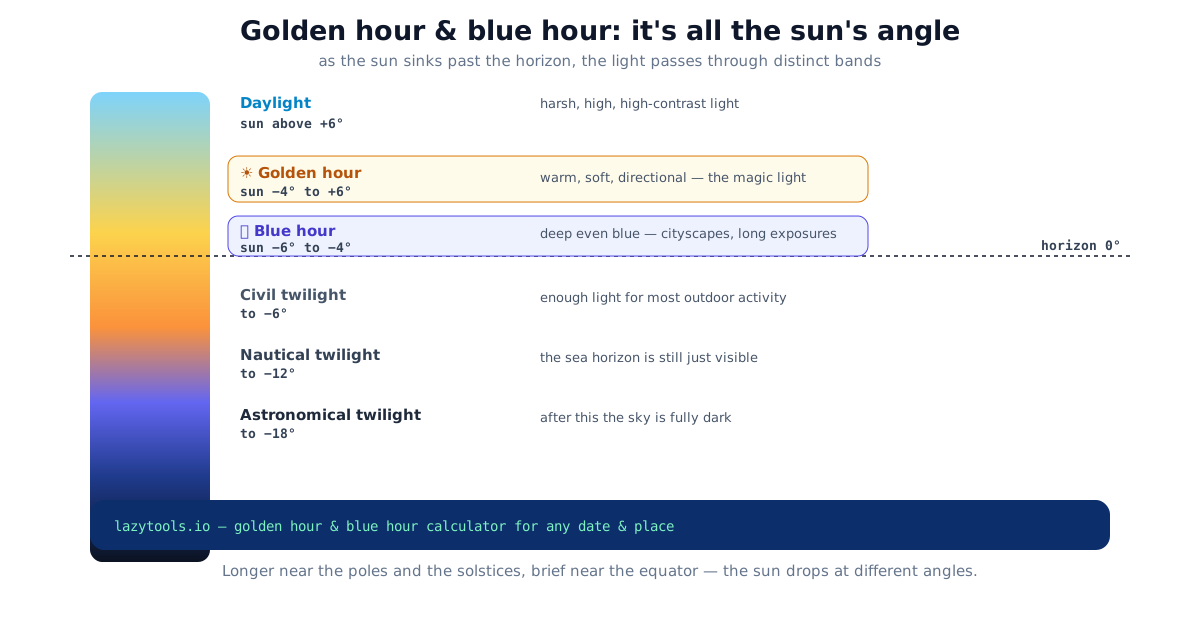
As the sun rises and sets it sweeps through a range of elevation angles, how many degrees it sits above (positive) or below (negative) the horizon. The light at each angle is distinct, and photographers and astronomers carve that range into named windows:
- Daylight (above +6°): the ordinary high sun, bright, cool-toned and harsh, with short hard shadows.
- Golden hour (−4° to +6°): the sun is low and its light rakes across the scene. Traveling through more atmosphere strips out blue, leaving warm gold; the low angle gives long, soft shadows and depth. This is the light landscape and portrait photographers chase.
- Blue hour (−6° to −4°): the sun is just below the horizon. Direct sunlight is gone, but the sky glows a deep, even blue, beautiful for cityscapes, where artificial lights balance the twilight, and for long exposures.
The three twilights
Keep going down and you pass the formal twilight stages, each a threshold of darkness:
- Civil twilight, to −6°: there’s still enough natural light for most outdoor activities without artificial light. This is the practical “dawn” and “dusk,” and in many countries it defines legal lighting-up times for vehicles.
- Nautical twilight, to −12°: dark enough that the brighter stars appear, but sailors can still make out the sea horizon against the sky (hence the name), the condition once needed to take star sightings with a sextant.
- Astronomical twilight, to −18°: the last faint glow. Below −18° the sun no longer contributes measurable skylight, so the sky is fully dark, true night, which is when astronomers observe the faintest objects.
The full sun-angle ladder at a glance
Here is the whole sequence in one reference, from high midday sun down to true night. The elevation figures are the conventional boundaries; note that different apps and almanacs sometimes shift the golden/blue-hour edges by a degree or two, but the twilight limits of −6°, −12° and −18° are fixed international definitions.
| Window | Sun elevation | Character of the light | Best for |
|---|---|---|---|
| Daylight | above +6° | Bright, cool, hard shadows | General shooting; fill the shadows |
| Golden hour | −4° to +6° | Warm, soft, strongly directional | Portraits, landscapes, backlighting |
| Blue hour | −6° to −4° | Cool, deep, even blue glow | Cityscapes, architecture, long exposures |
| Civil twilight | 0° to −6° | Fading ambient light, no direct sun | Practical dawn/dusk; balanced sky-vs-lights |
| Nautical twilight | −6° to −12° | Dark sky, bright stars appear | Silhouettes, star-and-horizon shots |
| Astronomical twilight | −12° to −18° | Near-black, faint residual glow | Milky Way framing, deep-sky prep |
| Night | below −18° | Fully dark | Faint-object astrophotography |
Golden hour and civil twilight overlap on purpose: golden hour is defined by the quality of light near the horizon, while civil twilight is defined strictly by the sun sitting between the horizon and −6°. In the morning, blue hour comes first and gives way to golden hour as the sun climbs; in the evening the order reverses.
Why the windows aren’t the same length everywhere
Since these are angle bands, how long the sun takes to cross them depends on how steeply it rises and sets:
- Near the equator, the sun goes almost straight up and down, crossing the golden-hour band quickly, golden hour can be under 40 minutes, and there’s little twilight.
- Near the poles and around the solstices, the sun skims along at a shallow angle, taking hours to cross the same few degrees, long, lingering golden hours. Push far enough and the sun never drops to −18° at all, so there’s no astronomical night in high-latitude summer.
That’s also why golden hour can’t be a fixed 60 minutes: the same sun angle takes a different amount of clock time depending on where and when you are.
A worked example: two cities, same day
The quickest way to feel the latitude effect is to compare two places on the same date. Take a day near the June solstice. In Singapore (about 1° north of the equator), the sun climbs almost vertically after sunrise, so it races through the −4° to +6° golden-hour band. The evening golden window there is short, on the order of half an hour.
In Reykjavík, Iceland (about 64° north), the same solstice sun barely climbs; it crawls along the horizon at a shallow angle. Crossing those same ten degrees of elevation can take a couple of hours, and the sun may never sink to −18°, so there is no astronomical night at all, the sky stays in permanent twilight through the small hours. Same sun, same ten-degree band, wildly different clock times. The lesson: never trust a generic “golden hour is 60 minutes” rule of thumb. Compute it for your exact coordinates and date.
Practical tips for using each window
- Arrive early, stay late. The best colour often lands in the few minutes on either side of the “official” boundary. Be set up and metered before blue hour begins, and keep shooting into civil twilight.
- Watch the direction, not just the warmth. Golden hour’s magic is as much about the low angle, long shadows, rim light, texture across a landscape, as about colour. Position your subject to use side- or back-light.
- Blue hour balances artificial light. For cityscapes, the sky’s brightness matches building and street lights for only a short window in blue hour; shoot then and neither the sky nor the lights blow out.
- Clear air sharpens the effect; haze softens it. Dust, humidity and pollution scatter more light, muting golden tones and lifting the horizon glow. A crisp, dry day gives the most saturated colour.
- Check for obstructions. These angles assume a flat horizon. Mountains, buildings or trees raise your effective horizon, so direct sun disappears earlier in the evening and appears later in the morning than the numbers suggest.
Find it for your shoot
Because every window is a sun-elevation threshold, you can compute the exact times from just the date, latitude, longitude and time zone, no internet lookup required. The golden hour calculator does exactly that with the NOAA solar-position algorithm, giving you the morning and evening golden and blue hours plus all three twilight boundaries for any day and place. Planning around the sun more broadly? The sunrise & sunset calculator covers the day’s length, and once you’re shooting, the depth of field calculator helps you nail the focus. Everything runs in your browser.
Golden and blue hour boundaries follow the common −4°/+6° and −6°/−4° sun-elevation conventions (sources vary by a degree or two); the twilight limits of −6°, −12° and −18° are the standard civil, nautical and astronomical definitions. Times are computed with the NOAA solar-position algorithm. Source: NOAA Solar Calculator.
Frequently asked questions
What is golden hour?
The period after sunrise and before sunset when the sun is low, roughly −4° to +6° in elevation, giving warm, soft, directional light. It's defined by the sun's angle, not a fixed 60 minutes, so its length varies with latitude and season.
What is the difference between golden hour and blue hour?
Golden hour (sun about −4° to +6°) gives warm, golden light around sunrise and sunset. Blue hour (sun about −6° to −4°, so just below the horizon) gives cool, deep-blue even light in the twilight before sunrise and after sunset.
How long does golden hour last?
It depends on your latitude and the date. Near the equator the sun drops steeply and golden hour can be under 40 minutes; near the poles and around the solstices the sun skims the horizon and it can last hours. Calculate it for your exact place and day.
What are civil, nautical and astronomical twilight?
Stages of darkness by how far the sun is below the horizon: civil to −6° (still enough light to be outside), nautical to −12° (sea horizon just visible), astronomical to −18° (sky fully dark). Below −18° is true night.
Why is golden hour light better for photos?
When the sun is low, its light travels through more atmosphere, scattering away blue and leaving warm tones, and it comes from the side, creating soft shadows and depth. High midday sun is harsh, cool and flat by comparison.
How do I find golden hour for my location?
Because it's a sun-angle window, it can be computed from your date, latitude, longitude and time zone with a solar-position algorithm, no live data needed. The golden hour calculator gives the morning and evening windows plus all the twilight times.