
explainer
How Much Layover Time Do You Need? Minimum Connection Times vs. What's Actually Safe
By Uttam Regmi · Published 2026-07-18 · Updated 2026-07-18 · 4 min read · Fact-checked, sources cited
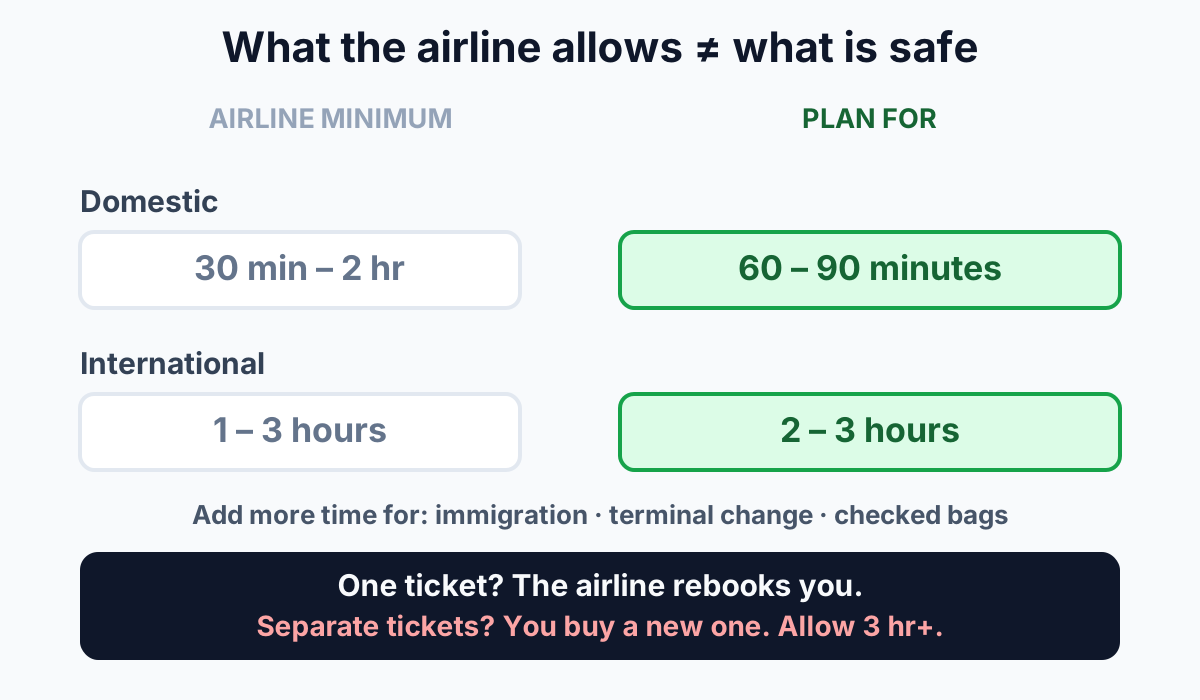
Airlines will sell you a 30-minute domestic connection, but a realistic minimum is 60-90 minutes domestically and 2-3 hours internationally. The “minimum connection time” (MCT) printed in a booking system is the shortest the airline’s software will allow, calculated for ideal conditions, an on-time inbound flight and a passenger who knows the airport. It is a feasibility floor, not a recommendation. And one factor outranks the clock entirely: whether both flights are on a single ticket.
What “minimum connection time” actually is
Every airport, airline pairing has a published MCT: the shortest gap the reservation system will let you book. It reflects a measured walking time between gates or terminals, under good conditions, with the inbound flight arriving on schedule.
Two things it does not account for:
- Your inbound flight being late. This is the single most common cause of a missed connection, not slow passengers. US DOT Bureau of Transportation Statistics, Causes of Flight Delays air-travel data consistently shows late-arriving aircraft as a leading driver of onward disruption. A tight-but-legal connection assumes an on-time arrival you can’t control.
- You, specifically. MCT assumes a passenger who moves briskly and knows where they’re going, not someone with a stroller, mobility needs, or a first visit to a sprawling hub.
So an MCT-legal connection is bookable, not comfortable.
Realistic minimums
| Connection type | Typical airline MCT | Plan for |
|---|---|---|
| Domestic → domestic (same airline) | 30 min, 2 hr | 60-90 min |
| Domestic → international | 1-2 hr | 2 hr+ |
| International → domestic (with immigration) | ~2-2¼ hr | 2.5-3 hr |
| International → international | 1-3 hr | 2-3 hr |
| Different airlines / separate tickets | n/a | 3 hr+ |
Work out your own gap with the layover calculator, which accounts for terminal changes and whether you’ll clear immigration.
The factor that matters more than minutes: one ticket or two?
This is the part travellers most often get wrong, and it costs the most.
Booked as a single itinerary (one ticket, even across partner airlines): if the inbound flight is late and you miss the connection, the airline is responsible for rebooking you, usually on the next available flight, at no extra fare. Your bags are also checked through.
Booked as two separate tickets (say, a cheap low-cost flight in, a different carrier out): the second airline has no obligation to you whatsoever. A missed connection means a new ticket at walk-up prices, and you’ll likely need to collect and re-check your bags in between. The saving that made two tickets attractive can evaporate in one delay.
If you self-connect on separate tickets, give yourself at least three hours, and be honest that you’re self-insuring the risk.
What eats your layover
Time disappears in predictable places:
- Immigration and customs. The big one. Arriving internationally into a country where you must clear immigration, collect checked bags, clear customs, then re-drop bags and pass security again can consume 90 minutes on its own.
- Terminal changes. Some hubs need a shuttle bus, train or a landside transfer that re-enters security.
- Checked bags on separate tickets. You must collect and re-check them.
- Deplaning. From wheels-down to actually being off the aircraft is commonly 10-20 minutes, and longer from a remote stand with bus transfer. Your “1 hour” connection may really be 40 minutes.
- Passport control on departure, in some regions.
When a long layover is the smarter buy
Very long layovers aren’t purely a cost. A 4-6 hour gap can be the difference between a stressful sprint and a meal, and many airlines offer free or cheap stopover programmes letting you spend a day or more in the hub city. If the itinerary already forces a long wait, check whether the airline’s stopover option turns it into a bonus destination.
The genuine downside of very long layovers is fatigue on the far side, especially if you’re already crossing several time zones, worth weighing alongside jet lag recovery.
A quick decision checklist
Before booking a tight connection, ask:
- Is it one ticket? If not, triple the buffer.
- Do I clear immigration in between? Add 60-90 minutes.
- Do I change terminals? Add 30+ minutes.
- Is the inbound a long-haul flight or a route with a poor on-time record? Add margin.
- Is it the last flight of the day? If so, a misconnection means an overnight, buy the buffer.
- Do I have checked bags on separate tickets? Add collection and re-check time.
If two or more of those apply, take the later flight.
Frequently asked questions
Is a 1 hour layover enough time?
For a domestic-to-domestic connection on a single ticket it can work, but it is tight. A realistic minimum is 60 to 90 minutes domestically, so a 1 hour layover leaves little margin if your inbound flight is delayed.
What is minimum connection time (MCT)?
MCT is the shortest gap an airline's reservation system will let you book between two flights at a given airport. It reflects measured walking time under ideal conditions with an on-time inbound flight. It is a feasibility floor, not a recommendation.
How much layover time do I need for an international connection?
Plan for 2 to 3 hours for international connections, and allow even more when you have to clear immigration or customs. An international-to-domestic connection with immigration realistically needs about 2.5 to 3 hours.
Does it matter if my flights are on one ticket or separate tickets?
Yes, this matters more than the clock. On a single ticket the airline is responsible for rebooking you if you misconnect. On separate tickets you own the loss, so allow 3 hours or more between separately ticketed flights.
What is the most common reason people miss a connection?
A delayed inbound flight, not a slow walk through the airport. A late arriving first flight is the single most common cause of a missed connection, which is why a tight but legal connection is riskier than it looks.
When should I add extra layover time beyond the minimum?
Add time for clearing customs or immigration, changing terminals, collecting and rechecking bags, and navigating large hub airports. Any of these can easily consume the buffer an MCT-legal connection assumes you have.