
explainer
How to Pick a Fair Random Winner (Names, Raffles and Giveaways)
By Uttam Regmi · Published 2026-08-06 · Updated 2026-08-23 · 6 min read · Fact-checked, sources cited
“I’ll just pick someone at random” almost never is. People unconsciously favour the start or end of a list, familiar names, or a “random” number that isn’t. If the choice matters, a giveaway winner, who presents first, a prize draw. You want a genuinely fair method. Here’s what fairness means and how to do it with the Random Name Picker.
What “fair” actually means
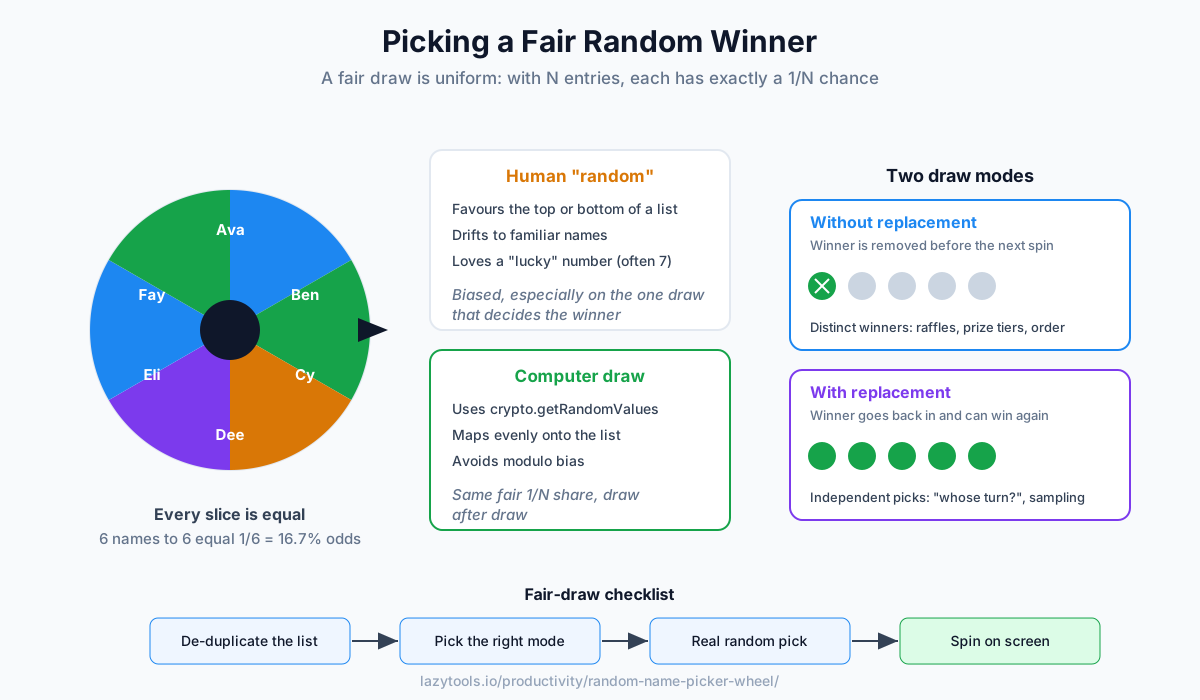
A fair single draw is uniform: every entry has exactly the same probability of being chosen. With N names, each has a 1/N chance, no more for the first name, no less for the hard-to-pronounce one. So with 20 entrants each has a 1/20 = 5% chance; with 200 each has 0.5%. Nothing about position, spelling, or how recently you added a name should shift those odds.
Humans are bad at this. Asked to “pick someone at random,” we drift toward names near the top or bottom of a list, names we recognise, or a “random” number that’s really a favourite (a lot of people land on 7). “Pick a number in your head” is worse still, because our guesses cluster in predictable ways. A computer using a proper random source doesn’t have those habits: it gives each entry its fair share, draw after draw, without knowing or caring who the names belong to.
There’s also a difference between fair on average and fair on the day. Over thousands of draws almost any sloppy method looks roughly even, but a single giveaway is one draw, and that’s exactly where human bias shows up. Fairness has to hold for the one spin that actually decides the winner, not just in the long run.
With replacement vs. without
The other half of fairness is what happens on the next draw:
- With replacement, the winner goes back in the pool, so they can win again. Each spin is an independent, uniform pick over the whole list. Good for “whose turn is it?” repeated over time.
- Without replacement, the winner is removed before the next draw. You get a sequence of distinct winners, and everyone left keeps an equal chance among the remaining pool. This is what a raffle, multiple prize tiers, or a running order needs.
Picking the wrong mode is the most common way a “fair” draw quietly becomes unfair, e.g. running a three-prize giveaway with replacement means one person could win twice while others can’t win once.
A worked example
Say you’re drawing 3 prizes from 50 entrants. With without replacement, the first spin picks from all 50, the second from the remaining 49, the third from 48, three different people, and every entrant has an equal shot at some prize. With replacement, all three spins draw from the full 50, so it’s possible (if unlikely) for the same person to be pulled twice or even three times. For a raffle that’s clearly wrong; for something like “pick tonight’s washing-up volunteer” over many nights, replacement is exactly what you want, because last night’s loser should be back in tonight’s pool.
| Scenario | Mode | Why |
|---|---|---|
| Raffle / prize draw | Without replacement | Each winner takes one prize; nobody wins twice |
| 1st / 2nd / 3rd place tiers | Without replacement | Distinct people fill distinct places |
| Presentation or turn order | Without replacement | You’re arranging everyone into a sequence |
| ”Whose turn is it?” each day | With replacement | Yesterday’s pick can be picked again today |
| Simulations / repeated sampling | With replacement | Each trial is meant to be independent |
| Weighted entries (extra tickets) | Either, keep duplicates | More lines = more chances, on purpose |
Is the spinning wheel real or just a show?
A wheel is a nice way to show a draw, but the honesty is in the order of operations. A trustworthy wheel:
- Chooses a uniformly random entry first.
- Then spins so that exact segment stops under the pointer.
That way the animation is presentation layered over a real, fair pick, the winner displayed is exactly the one that was chosen, with no rounding or “wherever it happens to stop” fudge. (A wheel that instead reads off wherever a physics fling lands can be subtly biased by the animation.)
Where the randomness comes from
“A computer picks it” only helps if the underlying randomness is sound. Browsers expose a
cryptographic-quality source (crypto.getRandomValues) that’s far better suited to a fair draw than the
basic Math.random used for throwaway effects. The practical difference for a giveaway is small, either
is vastly fairer than a human, but a well-built picker reaches for the stronger source and maps it evenly
onto your list so there’s no leftover bias toward the first or last few names.
One subtle trap worth knowing: naively squashing a random number into a range can very slightly favour some entries (a “modulo bias”). It rarely matters at the scale of a classroom or a giveaway, but a careful tool avoids it, which is one more reason to use a purpose-built picker rather than a spreadsheet formula you half-remember.
Common ways a “fair” draw goes wrong
- Silent duplicates. A pasted list with the same name twice hands that person double the odds. Sometimes intended, often not, check before you spin.
- Blank lines and stray whitespace. Empty entries can become “phantom” slots that occasionally win nobody. Trim the list first.
- Re-spinning until you like the result. Quietly re-drawing because you didn’t want that winner throws fairness out entirely, the first honest draw is the result.
- Wrong replacement mode, as above, the single most common structural mistake.
- Doing it off-screen. For anything public, a draw nobody witnessed is hard to trust even when it was perfectly fair.
A quick fairness checklist
- De-duplicate unless you want weighting, each line is a separate chance, so a repeated name gets more of them.
- Pick the right replacement mode, remove winners for raffles and multi-prize draws.
- Use a real random pick, not a human guess.
- Keep it transparent, for a public giveaway, spin on screen so entrants can see the draw happen.
Draw a fair winner privately
The Random Name Picker does all of this in your browser: paste any list, spin for a uniformly random winner, and switch on “remove the winner” for draws-without-replacement. Because the list and the randomness stay on your device, a class roster or customer entry list is never uploaded, and it works offline, so you can run a fair draw anywhere.
For a giveaway that people are watching, that combination is exactly what you want: a genuinely uniform pick, the right replacement mode for however many prizes you’re awarding, and an on-screen spin that shows the draw happening, all without your entrant list ever leaving your browser. Fair in the maths, and fair in a way your audience can see.
Frequently asked questions
How do I pick a fair random winner from a list of names?
Give every entry an equal chance and let a computer make the draw. Paste your names into a random name picker, spin, and it selects one uniformly at random, each name has exactly the same probability. Doing it by eye or 'thinking of a number' is biased; a proper picker isn't.
What does 'with or without replacement' mean?
With replacement, the same entry can win again on the next draw (each spin is independent over the full list), use it for things like deciding whose turn it is repeatedly. Without replacement, a winner is removed before the next draw, so you get a sequence of distinct winners, use it for raffles, prize tiers, or picking a running order.
Is a spinning wheel actually random, or just for show?
It depends on the tool. A well-built wheel first chooses a uniformly random entry and then animates so that exact segment lands under the pointer, so the spin is real, not decorative, and the shown winner is genuinely the random pick. The animation is just presentation over a fair draw.
How do I run a giveaway draw with several winners?
Use draw-without-replacement: spin for the first winner, remove them, spin again for the second, and so on. Each remaining entrant keeps an equal chance among those left, which is the fair way to award multiple distinct prizes from one entry list.
Is it fair if some names appear more than once?
A duplicate name effectively gets more chances, because each line is a separate entry. That's sometimes intended (weighted entries, e.g. more raffle tickets), but if you want everyone equal, remove duplicates first so each person appears exactly once.
Do I have to upload my list of names anywhere?
No, a good picker runs entirely in your browser, so a class roster, customer list or giveaway entries never leave your device. The LazyTools Random Name Picker draws locally and uploads nothing, and it works offline.