
explainer
Moon Phases Explained: Why There Are 8, Why They Take 29.5 Days, and Why There's No Dark Side
By Uttam Regmi · Published 2026-07-18 · Updated 2026-07-18 · 5 min read · Fact-checked, sources cited
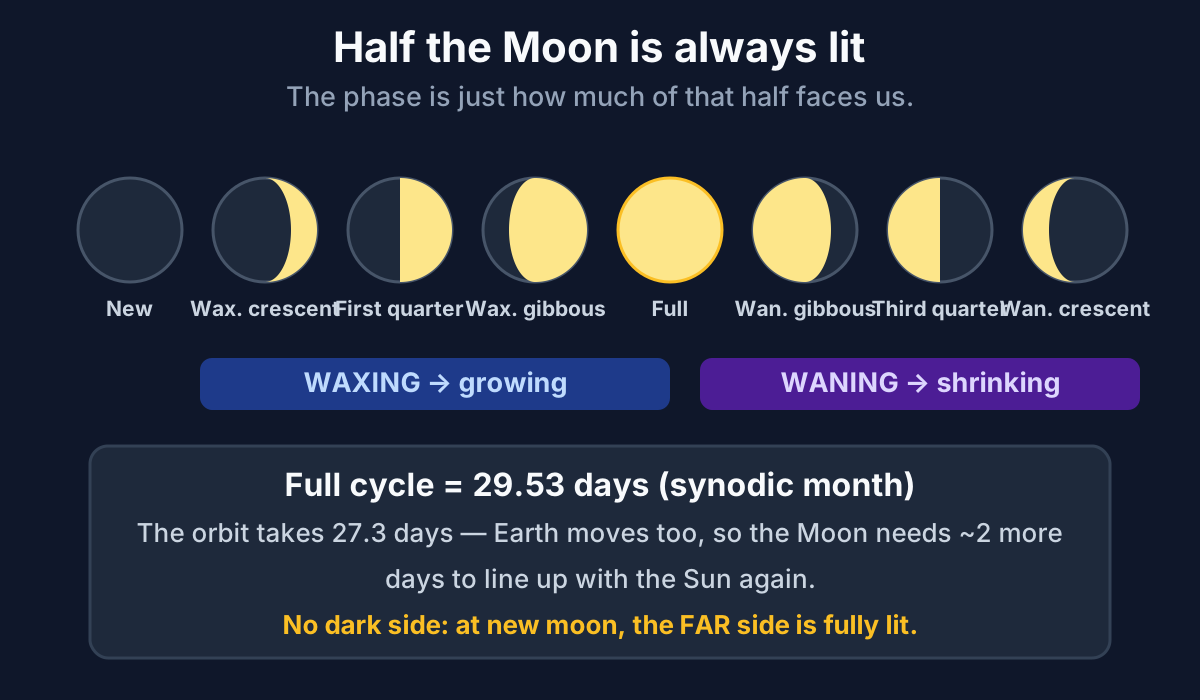
The Moon’s phases are caused by the changing angle between the Sun, Earth and Moon, not by Earth’s shadow. Half the Moon is always lit by the Sun; what changes is how much of that lit half we can see from here. The full cycle takes 29.5 days, and the eight named phases run new → waxing crescent → first quarter → waxing gibbous → full → waning gibbous → third quarter → waning crescent. And there is no permanently dark side: the far side gets exactly as much sunlight as the near side.
The one idea that makes it click
The Sun always lights exactly half of the Moon, the half pointing at it. That never changes.
What changes is where the Moon is in its orbit relative to us, and therefore how much of that sunlit half is turned toward Earth:
- Moon roughly between Earth and Sun → its lit half faces away from us → we see almost nothing. New moon.
- Earth roughly between Sun and Moon → the lit half faces us fully. Full moon.
- Moon at right angles → we see half of the lit half, so a disc that looks half-lit. Quarter moon.
This is why the very common “the Earth’s shadow causes the phases” explanation is wrong. Earth’s shadow does fall on the Moon occasionally, that’s a lunar eclipse, and it only happens at some full moons, a couple of times a year, not monthly.
The eight phases in order
| Phase | Lit (as seen from Earth) | Roughly visible |
|---|---|---|
| New moon | 0% | Not visible (up with the Sun) |
| Waxing crescent | 1-49% | Evening, west after sunset |
| First quarter | 50% | Afternoon and early evening |
| Waxing gibbous | 51-99% | Late afternoon to early morning |
| Full moon | 100% | All night, rises at sunset |
| Waning gibbous | 99-51% | Late evening to morning |
| Third quarter | 50% | Midnight to midday |
| Waning crescent | 49-1% | Pre-dawn, east before sunrise |
Two naming quirks worth knowing:
- “Quarter” moons look half lit. The name counts progress through the cycle, first quarter is one quarter of the way round, not the fraction illuminated.
- “Gibbous” just means humped: more than half but not full.
Check tonight’s phase with the moon phase calculator.
Waxing and waning
- Waxing, the lit fraction is growing, from new toward full. Waxing moons are visible in the evening sky.
- Waning, the lit fraction is shrinking, from full back toward new. Waning moons are visible in the early morning sky.
Because a full moon rises around sunset and a new moon rises with the Sun, the Moon’s rise and set times shift steadily through the cycle; you can line them up against your local sunrise and sunset times.
A field trick for the Northern Hemisphere: if the Moon’s right side is lit, it’s waxing; if the left side is lit, it’s waning. In the Southern Hemisphere it’s reversed, because you’re looking at the same Moon from an effectively upside-down vantage point.
Why 29.5 days and not 27.3
The Moon completes one orbit of Earth relative to the distant stars in 27.3 days, the sidereal month. But the phase cycle takes 29.53 days, the synodic month. The two differ, and the reason is that Earth doesn’t sit still.
While the Moon goes around us, Earth travels about 1/12 of the way around the Sun. So after a full 27.3-day orbit, the Sun, Earth, Moon geometry has shifted, and the Moon must travel roughly two extra days to line up the same way again. Phases depend on that Sun-relative alignment, so they follow the longer synodic month.
That 29.53-day figure is also why lunar calendar months are 29 or 30 days, and why the phase drifts against our fixed-length Gregorian months.
Tidal locking: the same face, always
The Moon rotates. It just does so at precisely the rate that keeps one face toward us. One rotation takes exactly as long as one orbit. That’s tidal locking, and it isn’t a coincidence: over hundreds of millions of years Earth’s gravity raised a slight bulge on the Moon and dragged on it, gradually braking its spin until the rotation matched the orbit and the tugging stopped.
It’s a common outcome in the Solar System, most large moons are tidally locked to their planets.
There is no dark side
The far side receives just as much sunlight as the near side. In fact:
- At new moon, the near side faces away from the Sun and is dark, while the far side is fully lit.
- At full moon, the reverse: the near side is fully lit and the far side is in darkness.
The far side has a two-week day and a two-week night, exactly like the near side. What makes it distinct is that it’s permanently hidden from Earth, not permanently dark. It stayed genuinely unseen until a Soviet probe photographed it in 1959.
(It’s also visibly different: the far side has far fewer of the large dark plains, the maria, that form the “man in the Moon” pattern on the near side.)
Frequently asked questions
What causes the phases of the Moon?
Phases come from the changing angle between the Sun, Earth and Moon, which changes how much of the Moon's permanently sunlit half is turned toward us. They are not caused by Earth's shadow.
How long is the full cycle of Moon phases?
The synodic month is about 29.5 days (roughly 29.53). It is longer than the 27.3-day orbit because the Earth is also moving around the Sun, so the Moon has to travel a bit further to line up the same way again.
What is the difference between waxing and waning?
Waxing means the lit portion is growing, from new moon toward full. Waning means it is shrinking, from full moon back toward new.
Is there really a dark side of the Moon?
No. The far side gets exactly as much sunlight as the near side; at new moon the far side is the fully lit one. We always see the same face because the Moon is tidally locked, rotating once per orbit.
Why is a quarter moon shaped like a half disc?
The name 'quarter' refers to the Moon being a quarter of the way through its cycle, not to how much of the disc is lit. At first and third quarter we see about 50% of the disc illuminated.