
explainer
When Is Your Fertile Window? How to Estimate Ovulation
By Uttam Regmi · Published 2026-07-28 · Updated 2026-07-28 · 6 min read · Fact-checked, sources cited
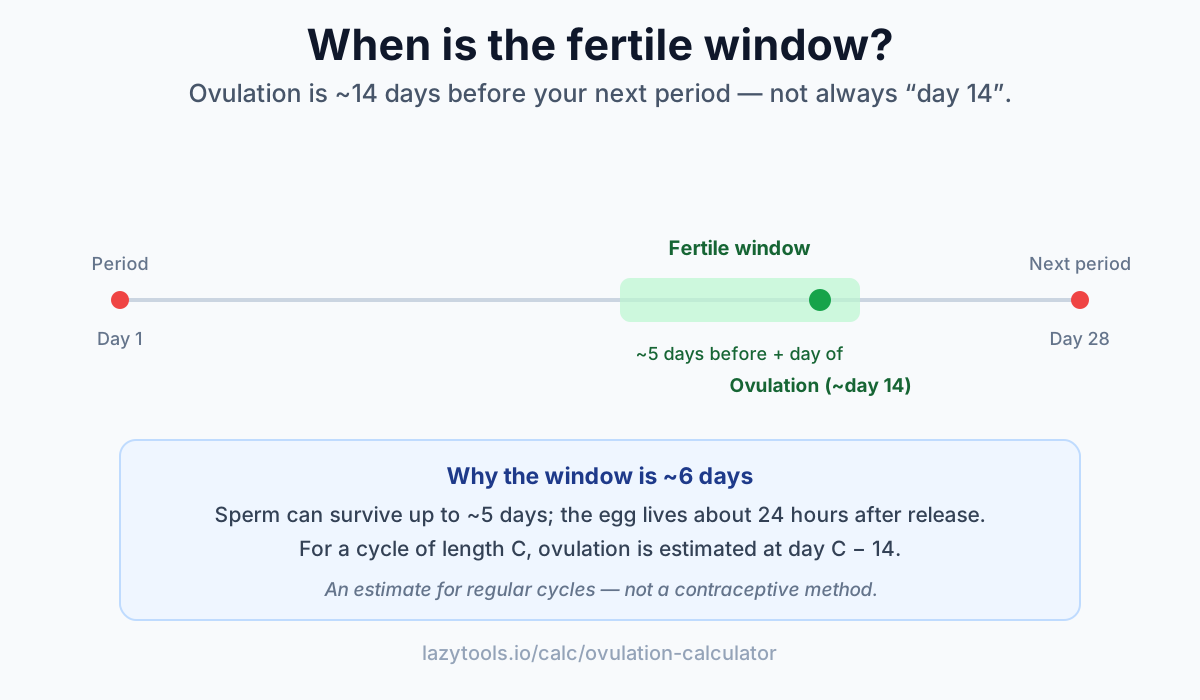
Ovulation typically happens about 14 days before your next period, and your fertile window is roughly the 6 days ending on ovulation day, the 5 days before it plus the day itself. For a regular 28-day cycle that puts ovulation around day 14, with the fertile window spanning about days 10-15. But the key is those 14 days before the next period, not a fixed “day 14”, so if your cycle is longer or shorter, your ovulation day shifts.
Why 14 days before the next period
A menstrual cycle has two phases, and understanding the difference between them is the whole trick to estimating ovulation. Day 1 is the first day of bleeding.
- The follicular phase runs from the start of your period until ovulation. This is where a follicle matures and estrogen rises. Its length varies, between people, and from month to month in the same person. This is the part of the cycle that stretches or shrinks when your total cycle length changes.
- The luteal phase runs from ovulation to the start of your next period. After the egg is released, the ruptured follicle becomes the corpus luteum, which produces progesterone on a fairly fixed schedule. This phase is much more consistent, commonly around 12-14 days.
Because the luteal phase holds roughly steady while the follicular phase does the moving, ovulation is best estimated by counting backwards from your next expected period, not forwards from your last one. For a cycle of length C, ovulation is estimated at day C − 14.
A worked example
Say your period started on the 3rd of the month and your cycle is typically 30 days long.
- Your next period is expected around day 30, i.e. the 2nd of next month (30 days after the 3rd).
- Ovulation is about 14 days before that: day 30 − 14 = day 16, which lands on the 18th of this month.
- The fertile window is roughly the 5 days before plus ovulation day, about day 11 to day 16 (the 13th to the 18th).
Notice ovulation is not on day 14 here; the longer cycle pushed it to day 16. The ovulation calculator runs exactly this arithmetic from the first day of your last period and your typical cycle length, and marks both the fertile window and your next expected period so you don’t have to count squares on a calendar.
Cycle length changes everything
Here’s how the estimate shifts across common cycle lengths. Notice the fertile window slides later as the cycle gets longer, while the luteal phase stays put:
| Cycle length (days) | Estimated ovulation day | Approx. fertile window | Next period |
|---|---|---|---|
| 24 | Day 10 | Days 5-10 | Day 24 |
| 26 | Day 12 | Days 7-12 | Day 26 |
| 28 | Day 14 | Days 9-14 | Day 28 |
| 30 | Day 16 | Days 11-16 | Day 30 |
| 32 | Day 18 | Days 13-18 | Day 32 |
| 35 | Day 21 | Days 16-21 | Day 35 |
The pattern is the point: the day of ovulation moves with cycle length, but it stays anchored roughly 14 days from the end of the cycle.
Why the fertile window is about six days
You can conceive from intercourse on several days around ovulation, not just the day itself, because:
- Sperm can survive up to about 5 days in fertile cervical mucus, so sex in the days before ovulation can still result in conception.
- The egg lives about 12-24 hours after it’s released.
Put together, that gives a fertile window of roughly the 5 days before ovulation plus ovulation day, about six days, with the highest chance in the 2-3 days leading up to and including ovulation.
The probability isn’t flat across those six days. It’s low at the start of the window (when sperm would have to survive several days to meet the egg), rises to a peak in the day or two before ovulation, and then drops off sharply once the egg’s short life is over. In classic studies of couples trying to conceive, essentially no pregnancies resulted from intercourse more than about five days before ovulation or on the day after it, which is where the “six-day window” figure comes from.
| Day relative to ovulation | Relative chance of conception |
|---|---|
| 5 days before | Low |
| 3-4 days before | Moderate |
| 1-2 days before | Highest |
| Ovulation day | High |
| Day after ovulation | Very low |
This is why timing intercourse in the couple of days before the expected ovulation day, rather than waiting for the day itself, tends to give the best odds. By the time many signs confirm ovulation has happened, the most fertile part of the window may already be closing. If a cycle does result in conception, you can turn that same estimated ovulation date into a projected due date with the due date calculator.
The limits of the calendar method
Calendar estimates are a useful starting point, but they assume a regular cycle. Real ovulation shifts with cycle variability, stress, illness, travel and life stage, so the actual day can be off from the estimate. A calendar can’t see ovulation. It only projects an average forward, so a cycle that runs a few days long or short one month will land ovulation somewhere the calendar didn’t predict.
For more accuracy, people combine the calendar with body signals that respond to the actual hormones of the current cycle:
- Ovulation predictor kits (OPKs) detect the surge in luteinizing hormone (LH) that typically precedes ovulation by roughly a day, giving a forward-looking heads-up.
- Basal body temperature (BBT) rises slightly after ovulation, driven by progesterone. This confirms ovulation happened but only after the fact, so it’s better for spotting your pattern over several cycles than for predicting today’s window.
- Cervical mucus becomes clearer, thinner and more stretchy (often compared to raw egg white) in the fertile days, then thickens again afterward.
Each method answers a slightly different question, predict versus confirm, so many people use two together:
| Method | Predicts or confirms? | Best for |
|---|---|---|
| Calendar / cycle math | Predicts (rough) | A starting estimate and planning ahead |
| OPK (LH test) | Predicts (~1 day ahead) | Timing intercourse in the current cycle |
| Cervical mucus | Predicts (approx.) | A low-cost daily body signal |
| Basal body temperature | Confirms (after) | Learning your personal pattern over cycles |
Important: this is general information, not medical advice, and the calendar method is not a reliable form of contraception. It doesn’t account for cycle variability or sperm survival well enough to prevent pregnancy. If you’re trying to conceive and it isn’t happening after several months, if your cycles are very irregular or you rarely get a period, or if you’re trying to avoid pregnancy, speak with a healthcare provider about the options that fit your situation.
Your cycle dates are personal data. A local calculator keeps them on your device.
Frequently asked questions
When is my fertile window?
Your fertile window is roughly the 6 days ending on ovulation day, i.e. the 5 days before ovulation plus ovulation day itself. Since ovulation is about 14 days before your next period, you can estimate the window by counting back from your next expected period.
Is ovulation always on day 14?
No. Day 14 only applies to a regular 28-day cycle. Ovulation is better estimated as day C minus 14 for a cycle of length C, so a longer cycle pushes ovulation later and a shorter cycle earlier.
Why is the fertile window about 6 days long?
Sperm can survive in the reproductive tract for up to about 5 days, and the egg lives roughly 24 hours after release. Combined, that gives a window of about 6 days ending on ovulation day.
Why count back 14 days from the next period instead of forward from the last one?
The luteal phase (ovulation to next period) is fairly constant at around 12 to 14 days, while the follicular phase varies. Counting backward from your next expected period uses the more consistent part of the cycle, giving a better estimate.
Can the calendar method be used as birth control?
No. The calendar method is only a rough estimate for people with regular cycles and is not a precise or medical determination. It should not be relied on as a form of birth control.
What do I need to estimate my ovulation day?
You need the first day of your last period and your typical cycle length. From those, ovulation is estimated at day C minus 14, and the ovulation calculator runs this arithmetic and marks the fertile window and next expected period for you.