
explainer
Oxidation Numbers: The Rules and How to Assign Them
By Uttam Regmi · Published 2026-07-11 · Updated 2026-08-23 · 6 min read · Fact-checked, sources cited
Oxidation numbers look intimidating but follow a short priority list, and the last unknown always falls out by balancing. Fix the elements that have rules (group 1 is +1, oxygen is −2, and so on), then solve the one that’s left so everything sums to the overall charge. For KMnO₄ that instantly gives Mn = +7.
The rules, in priority order
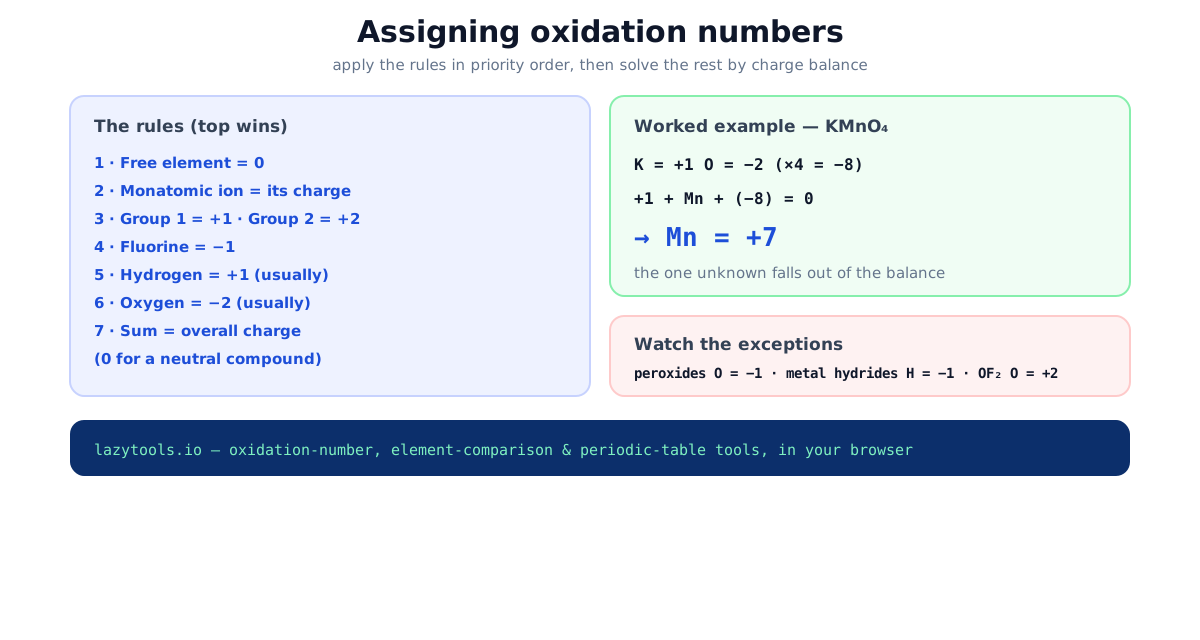
The rules are a priority list, when two could apply, the higher one wins:
- A free element is 0 (e.g. O₂, Na metal, S₈).
- A monatomic ion equals its charge (Na⁺ is +1, Cl⁻ is −1).
- Group 1 metals are +1; group 2 metals are +2.
- Fluorine is always −1.
- Hydrogen is +1, except in metal hydrides, where it’s −1.
- Oxygen is −2, except in peroxides (−1) and with fluorine (+2).
- The oxidation numbers sum to the overall charge (0 for a neutral compound; the ion’s charge otherwise).
The reason the list is ordered this way comes down to electronegativity. An oxidation number is what an atom’s charge would be if every bond were split and both shared electrons handed to the more electronegative partner. Fluorine is the most electronegative element, so it never loses that tug-of-war, which is why it sits high on the list and is always −1 in compounds. Oxygen is second only to fluorine, so it wins against nearly everything else and defaults to −2; the handful of times it doesn’t (peroxides, superoxides, bonds to fluorine) are exactly the cases where its partner is as electronegative or more.
The trick: solve the last one by balancing
Rule 7 is the workhorse. Once every element with a rule is fixed, the remaining element is whatever makes the sum come out right. Take KMnO₄:
- K (group 1) = +1
- O = −2, and there are four of them → −8
- Everything must sum to 0 (neutral compound):
+1 + Mn + (−8) = 0 - So Mn = +7.
No memorising manganese’s oxidation states. It drops out of the balance. The oxidation number calculator does exactly this: it applies the rules and solves the unknown for you.
A repeatable four-step method
Every problem reduces to the same procedure:
- Write the total charge the atoms must sum to, 0 for a neutral formula, or the ion’s charge.
- Assign every atom that has a rule (group 1, group 2, F, then H, then O), multiplying by how many of each atom appears.
- Let the unknown element be x and write one equation: fixed contributions + x = total charge.
- Solve for x. If two atoms of the unknown share the leftover, divide by that count.
More worked examples
| Compound / ion | Fixed contributions | Equation | Answer |
|---|---|---|---|
| H₂SO₄ | 2(+1) + 4(−2) = −6 | −6 + S = 0 | S = +6 |
| K₂Cr₂O₇ | 2(+1) + 7(−2) = −12 | −12 + 2·Cr = 0 | Cr = +6 each |
| HNO₃ | (+1) + 3(−2) = −5 | −5 + N = 0 | N = +5 |
| Fe₂O₃ | 3(−2) = −6 | −6 + 2·Fe = 0 | Fe = +3 each |
| SO₄²⁻ | 4(−2) = −8 | −8 + S = −2 | S = +6 |
| Cr₂O₇²⁻ | 7(−2) = −14 | −14 + 2·Cr = −2 | Cr = +6 each |
| ClO⁻ | (−2) | −2 + Cl = −1 | Cl = +1 |
For polyatomic ions, the only change is step 1: set the target sum to the ion’s charge instead of 0.
In the sulfate ion SO₄²⁻, S + 4(−2) = −2 gives S = +6, the same sulfur value it has inside neutral
H₂SO₄, which is a useful sanity check.
When the answer is a fraction
Oxidation numbers are a bookkeeping average, so they can come out fractional when identical atoms sit in
different environments. In magnetite, Fe₃O₄, balancing gives 3·Fe + 4(−2) = 0, so the average
iron is +8/3, the crystal actually contains a 1:2 mix of Fe²⁺ and Fe³⁺, and the fraction is their
mean. Likewise the average sulfur in thiosulfate, S₂O₃²⁻, works out to +2, even though the two
sulfur atoms are genuinely different. A fractional result is a signal, not a mistake.
Mind the exceptions
A short table covers essentially every case where the defaults are overridden:
| Situation | Element | Value | Example |
|---|---|---|---|
| Peroxide | O | −1 | H₂O₂, Na₂O₂ |
| Superoxide | O | −½ | KO₂ |
| Oxygen bonded to fluorine | O | +2 | OF₂ |
| Metal hydride | H | −1 | NaH, CaH₂ |
| Halogen with O or a lighter halogen | Cl, Br, I | positive | ClO⁻ (Cl +1), HClO₄ (Cl +7) |
The pattern is consistent: the defaults assume the usual electronegativity ordering, and the exceptions are precisely the compounds where that ordering is reversed. Oxygen only goes positive against fluorine; hydrogen only goes negative against a metal; chlorine only goes positive against oxygen or fluorine. When you spot a peroxide, a metal hydride, or a halogen paired with oxygen, override the default before you balance.
Why bother?
Oxidation numbers are how chemists track electron transfer. If an element’s oxidation number goes up, it was oxidised (lost electrons); if it goes down, it was reduced (gained electrons). That’s the foundation of balancing redox reactions, the same reactions the equation balancer handles, and of electrochemistry.
A quick worked case: in the reaction of iron with copper(II) sulfate, iron goes from 0 (free metal) to +2 in FeSO₄, while copper goes from +2 in CuSO₄ down to 0 as it plates out. Iron’s rise means it was oxidised; copper’s fall means it was reduced. The two changes are equal and opposite (+2 up, 2 electrons handed over; +2 down, 2 electrons received), which is exactly the balance the half-reaction method exploits.
One caution worth keeping straight: an oxidation number is not the same as an atom’s real charge. It is a deliberate fiction that pretends every bond is fully ionic so electrons can be counted cleanly. The two happen to coincide for monatomic ions, Na⁺ really does carry a +1 charge and an oxidation number of +1, but for atoms inside covalent molecules they diverge. Carbon in methane, CH₄, has an oxidation number of −4 yet carries almost no real charge, because its bonds to hydrogen are nearly nonpolar. Treat the number as an accounting tool, not a measurement. If you want the periodic-table context for who wins these electronegativity contests, the periodic table lays out the trends.
Quick summary
Assign oxidation numbers by applying the rules in priority order (free element 0; group 1 +1; group 2 +2; F −1; H +1; O −2), then solve the last element so everything sums to the overall charge, KMnO₄ gives Mn = +7. Watch the peroxide, metal-hydride and OF₂ exceptions. Let the oxidation number calculator do the balancing for you.
Sources: standard rules for assigning oxidation numbers as taught in general chemistry. Educational information.
Frequently asked questions
How do you find the oxidation number of an element?
Assign the elements that follow fixed rules, group 1 = +1, group 2 = +2, fluorine = −1, oxygen = −2, hydrogen = +1, then solve the remaining element so that all the oxidation numbers sum to the overall charge (0 for a neutral compound). In KMnO₄: +1 + Mn + 4(−2) = 0, so Mn = +7.
What are the oxidation number rules in order?
1) A free element is 0. 2) A monatomic ion equals its charge. 3) Group 1 metals are +1, group 2 are +2. 4) Fluorine is −1. 5) Hydrogen is usually +1. 6) Oxygen is usually −2. 7) The oxidation numbers sum to the overall charge. Higher rules take priority over lower ones.
Why does oxygen have exceptions?
Oxygen is −2 in almost all compounds, but −1 in peroxides (like H₂O₂), −½ in superoxides, and +2 when bonded to the more electronegative fluorine (OF₂). Apply the −2 default unless one of these special cases applies.
When is hydrogen −1?
In metal hydrides, compounds of hydrogen with a metal, such as NaH or CaH₂, hydrogen is −1. Bonded to nonmetals (as in water or acids), hydrogen is +1.
What is the difference between oxidation number and charge?
A charge is the actual electrical charge of an ion. An oxidation number is a bookkeeping value that assumes bonds are fully ionic, used to track electron transfer in redox reactions. They coincide for monatomic ions but not for atoms in covalent molecules.
Why are oxidation numbers useful?
They reveal what is oxidised (loses electrons, oxidation number rises) and what is reduced (gains electrons, oxidation number falls) in a reaction, which is the basis of balancing redox equations and understanding electrochemistry.