
explainer
Paper Sizes Explained: A4 vs Letter, and Every Size in mm, Inches and Pixels
By Uttam Regmi · Published 2026-08-23 · Updated 2026-08-23 · 5 min read · Fact-checked, sources cited
A4 is 210 × 297 mm (8.27 × 11.69 in); US Letter is 215.9 × 279.4 mm (8.5 × 11 in). They look interchangeable but they are not, Letter is about 6 mm wider and 18 mm shorter than A4, which is why a document laid out for one clips at the edge or leaves uneven margins on the other. Everything else follows two simple ideas: ISO sizes (A, B, C) all share a 1:√2 ratio so halving a sheet gives the next size down, while US, ANSI and Architectural sizes are their own fixed set. Pixels are never a fixed number. They are inches × DPI.
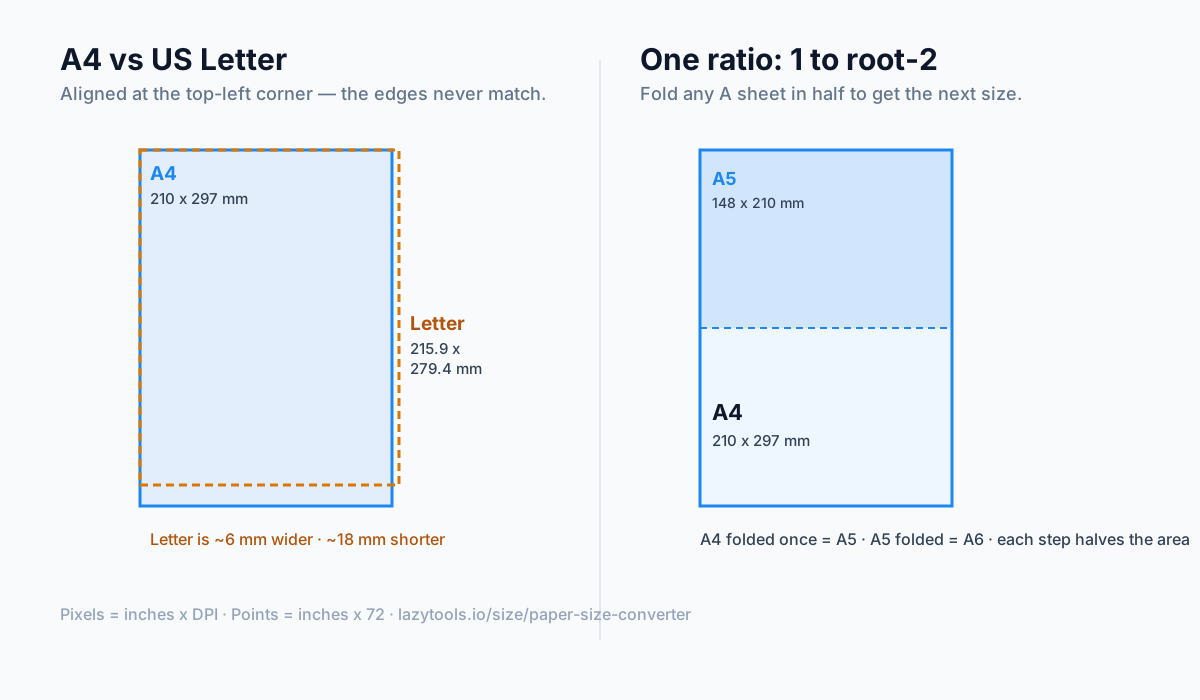
A4 vs US Letter: the difference that trips people up
The rest of the world uses A4 (210 × 297 mm); the US and Canada use Letter (8.5 × 11 in, or 215.9 × 279.4 mm). The gap is small but real:
| Width | Height | Area | |
|---|---|---|---|
| A4 | 210 mm | 297 mm | 623.7 cm² |
| US Letter | 215.9 mm | 279.4 mm | 603.2 cm² |
| Difference | Letter +5.9 mm | Letter −17.6 mm | A4 is ~3% larger |
Because Letter is wider and shorter, there is no scale factor that maps one onto the other, printing an A4 PDF on Letter paper (or vice versa) either crops content or adds white space. When it matters, set your document’s page size explicitly rather than trusting “Fit to page.” The paper size converter shows both side by side in every unit.
The ISO system: one ratio, endless sizes
Every ISO 216 A and B size shares the same shape: a width-to-height ratio of 1:√2 (about 1:1.414). That single choice has a neat consequence, cut any sheet in half across its long edge and the two halves keep the exact same ratio, so they are simply the next size down:
- A0 841 × 1189 mm → A1 594 × 841 → A2 420 × 594 → A3 297 × 420 → A4 210 × 297 → A5 148 × 210 …
A0 is defined as having an area of one square metre, which is why its sides are those slightly odd numbers. The B series (B0 = 1000 × 1414 mm) sits between the A sizes and is used for posters and books, while the C series (C4, C5, C6, DL) sizes envelopes to hold folded A-series letters, a C5 envelope fits an A5 sheet, or an A4 folded once.
mm, inches, points and pixels
A paper size is a physical thing (millimetres), but you often need it in other units:
| Unit | How it’s derived | A4 | US Letter |
|---|---|---|---|
| Millimetres | the standard | 210 × 297 mm | 215.9 × 279.4 mm |
| Inches | mm ÷ 25.4 | 8.27 × 11.69 in | 8.5 × 11 in |
| Points | inches × 72 | 595 × 842 pt | 612 × 792 pt |
| Pixels @ 96 DPI | inches × 96 | 794 × 1123 px | 816 × 1056 px |
| Pixels @ 300 DPI | inches × 300 | 2480 × 3508 px | 2550 × 3300 px |
The one that catches people out is pixels. There is no single “A4 in pixels”. It is inches × DPI. Use 96 DPI for on-screen or CSS work, 150 DPI for drafts, and 300 DPI for print-quality artwork (see the 300 DPI guide for why). Set the DPI in the paper size converter and it computes the exact pixel canvas for you.
US large-format: ANSI and Architectural
For engineering and architecture, the US uses two large-format families. ANSI runs A to E, where ANSI A is exactly US Letter and each step up roughly doubles the area (ANSI B = 11 × 17 in, the “Tabloid” size). Architectural (Arch A, E) is a parallel set with slightly different proportions favoured by architects. Both are in the converter’s chart alongside the ISO and US sizes.
Quick answers
- Landscape vs portrait: just swap width and height, A4 landscape is 297 × 210 mm.
- Business documents: A4 (or Letter in North America) for letters; A5 for booklets; DL or C5 envelopes.
- Print artwork: design at 300 DPI so the pixel canvas matches the physical size, an A4 flyer is 2480 × 3508 px.
Pick any size, orientation and DPI in the Paper Size Converter and read it back in millimetres, centimetres, inches, points and pixels, all in your browser, nothing uploaded.
Frequently asked questions
What is the size of A4 paper?
A4 is 210 × 297 mm, that's 21.0 × 29.7 cm, or 8.27 × 11.69 inches. In pixels it depends on the resolution: 794 × 1123 px at 96 DPI, and 2480 × 3508 px at 300 DPI for print.
Is A4 the same size as US Letter?
No. A4 is 210 × 297 mm and US Letter is 215.9 × 279.4 mm (8.5 × 11 in). Letter is about 6 mm wider and 18 mm shorter than A4, so a page designed for one will clip or leave uneven margins on the other.
Why does folding A4 in half give A5?
Every ISO A and B size has the same 1:√2 (about 1:1.414) width-to-height ratio. Halving a sheet across its long side preserves that ratio, so A4 folded in half is exactly A5, A5 folded is A6, and so on, each step halves the area.
How many pixels is A4 at 300 DPI?
Pixels = inches × DPI. A4 is 8.27 × 11.69 inches, so at 300 DPI it is 2480 × 3508 pixels. At 96 DPI (the CSS reference) it is 794 × 1123 pixels.
What are ANSI and Architectural paper sizes?
They are US large-format standards for engineering and architecture drawings. ANSI runs A, E (ANSI A equals US Letter, 8.5 × 11 in) and Architectural runs Arch A, E. Like ISO, each larger size roughly doubles the area of the one below it.
What size is A0 paper?
A0 is 841 × 1189 mm, its area is almost exactly one square metre, which is how the ISO 216 A series is defined. Every smaller A size is A0 halved the right number of times.