
explainer
How to Read the Periodic Table: Groups, Periods, Blocks and Trends
By Uttam Regmi · Published 2026-07-11 · Updated 2026-08-23 · 8 min read · Fact-checked, sources cited
The genius of the periodic table is that an element’s position tells you how it behaves. Read the columns and rows correctly and you can predict reactivity, size and bonding without memorising every element. Here’s how the layout works, and the handful of trends that fall out of it.
The two directions
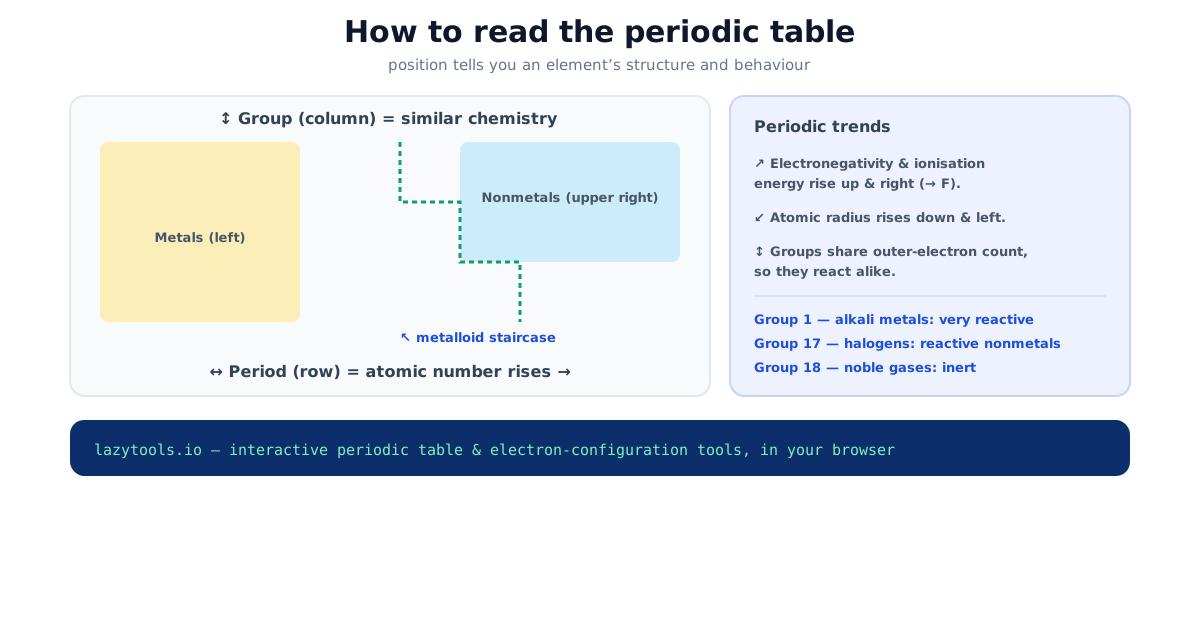
Groups run down (columns). Every element in a group has the same number of valence electrons, which is why they react alike:
- Group 1 (alkali metals), one outer electron, extremely reactive.
- Group 17 (halogens), seven outer electrons, reactive nonmetals.
- Group 18 (noble gases), full outer shell, almost completely inert.
Periods run across (rows). Moving left to right, the atomic number increases by one each step and electrons fill the same principal shell until it’s full, then a new period (a new shell) begins.
Click any element in the interactive periodic table to see its group, period, block and electron configuration for yourself.
A worked example: reading sodium’s coordinates
Take sodium (Na). It sits in group 1, period 3. Those two coordinates already tell you almost everything:
- Group 1 → one valence electron → it readily loses that electron to form a +1 ion (Na⁺) and is a soft, very reactive metal, just like lithium above it and potassium below it.
- Period 3 → it is filling its third principal shell, so its configuration is 1s² 2s² 2p⁶ 3s¹, one lone electron sitting in a new outer shell.
Compare it with chlorine (Cl) in group 17, period 3. Chlorine needs just one more electron to complete its outer shell, so it grabs one to form Cl⁻. Put the two together and the position alone predicts the product: Na⁺ and Cl⁻ attract into ordinary table salt, NaCl. You read the chemistry straight off the grid without memorising a single reaction.
The main groups at a glance
The “main-group” elements (the s- and p-blocks) are the easiest to reason about because valence electrons map directly onto the group number. This reference table covers the columns you meet most often:
| Group | Common name | Valence electrons | Typical ion | Behaviour |
|---|---|---|---|---|
| 1 | Alkali metals | 1 | +1 | Soft, very reactive metals |
| 2 | Alkaline earth metals | 2 | +2 | Reactive metals, harder than group 1 |
| 13 | Boron group | 3 | +3 | Mixed metal/metalloid character |
| 14 | Carbon group | 4 | ±4 | Forms covalent networks and chains |
| 15 | Pnictogens | 5 | −3 | Nonmetal to metal down the column |
| 16 | Chalcogens | 6 | −2 | Oxygen family, mostly nonmetals |
| 17 | Halogens | 7 | −1 | Reactive nonmetals, form salts |
| 18 | Noble gases | 8 (2 for He) | none | Full shells, essentially inert |
Notice how the ion charge tracks the group: metals on the left lose electrons (positive charge equal to the group number of valence electrons), while nonmetals on the right gain electrons to reach eight (charge = group electrons − 8). The transition metals in the middle break this neat rule because their d-electrons let them adopt several charges, iron can be Fe²⁺ or Fe³⁺, copper Cu⁺ or Cu²⁺.
The transition metals in the middle
The wide central block (groups 3-12) is where the tidy main-group logic loosens. Here the d-orbitals are filling, and because the outer s-electrons and the near-outer d-electrons are close in energy, these elements can lose different numbers of electrons in different compounds. That single fact explains most of what makes transition metals distinctive:
- Variable oxidation states. Manganese alone runs from +2 to +7, which is why permanganate (MnO₄⁻, manganese as +7) is such a strong oxidiser.
- Coloured compounds. Partly filled d-orbitals absorb visible light, so copper(II) salts look blue and chromium compounds run from green to orange depending on their state.
- Catalytic behaviour. Iron in the Haber process and platinum in a catalytic converter both rely on the flexible bonding those loose d-electrons allow.
If you want the exact filling order for any of them, the electron-configuration calculator spells it out, including the familiar half-filled and filled-shell exceptions at chromium and copper.
The four blocks
The table is split into blocks by which orbital is filling:
| Block | Where | What’s filling |
|---|---|---|
| s | groups 1-2 (+ He) | s-orbital |
| p | groups 13-18 | p-orbital |
| d | the transition metals | d-orbital |
| f | lanthanides & actinides (bottom rows) | f-orbital |
The block matches the last electron added, which is exactly what the electron-configuration calculator shows.
The trends that matter
Four trends do most of the heavy lifting, and they all point the same way relative to fluorine (top-right):
- Electronegativity (pull on shared electrons), increases up and to the right. Fluorine is the highest.
- Ionisation energy (energy to remove an electron), also increases up and to the right.
- Atomic radius (size), increases down and to the left, as new shells are added.
- Metallic character / reactivity of metals, increases down and to the left; caesium is about as reactive a metal as they come.
So the most reactive nonmetals huddle top-right, the most reactive metals bottom-left, and the calm noble gases sit in the far-right column. Recolour the periodic table by electronegativity to see the trend as a heat-map.
It helps to see the two directions side by side. Every major trend either rises toward fluorine (top-right) or away from it (bottom-left):
| Property | Direction it increases | Why |
|---|---|---|
| Atomic radius | Down and to the left | New shells add distance; extra nuclear charge across a row pulls electrons in |
| Ionisation energy | Up and to the right | Smaller atoms hold outer electrons more tightly |
| Electronegativity | Up and to the right | A small, highly charged nucleus pulls harder on shared electrons |
| Metallic character | Down and to the left | Loosely held outer electrons are given up easily |
A worked example: why is sodium bigger than chlorine?
Sodium and chlorine sit in the same period (3), so they have the same number of electron shells, yet a sodium atom is markedly larger. Reading the trends explains it. Moving from sodium (11 protons) across to chlorine (17 protons), each step adds a proton to the nucleus while the new electrons pile into the same third shell. The growing positive charge pulls that shell inward, so the atom shrinks as you go right. By chlorine the nucleus is tugging hard: chlorine is small and its high electronegativity lets it strip an electron from sodium outright. That is the same left-to-right contraction that makes the top-right corner the home of the small, electron-hungry nonmetals.
Now drop down a group instead. Fluorine and chlorine are both group 17 halogens, but chlorine sits one period lower with an extra filled shell, making it the larger atom. That is exactly why fluorine, higher up and smaller, is the more electronegative and more aggressively reactive of the two.
Metals, nonmetals and the staircase
Draw the diagonal “staircase” from boron down to astatine: metals are to its left (most of the table), nonmetals to its upper right, and the metalloids, boron, silicon, germanium, arsenic, antimony, tellurium, sit right along the line, sharing properties of both.
Why the bottom two rows are separated
The lanthanides (57-71) and actinides (89-103) are the f-block. Slotted into their true position the table would be 32 columns wide, so by convention they’re lifted out and shown below to keep it readable. They still belong between groups 2 and 3 of periods 6 and 7.
Reading an element you have never met
Put the pieces together and you can size up an unfamiliar element from its position alone. Take selenium (Se), atomic number 34, sitting in group 16, period 4:
- Group 16 (chalcogens) → six valence electrons → it tends to gain two to form Se²⁻, and it should behave like a heavier, less reactive cousin of oxygen and sulfur directly above it.
- Period 4, p-block → it is filling the 4p subshell, so it is a nonmetal but sits low enough that it edges toward metalloid character, consistent with its semiconductor uses.
- Trends → being lower and further left than fluorine, it is larger and less electronegative than the lighter nonmetals, so its bonds are more covalent and less ionic.
You reached all of that without looking up a single measured property. The two other numbers you often need for real calculations, an element’s atomic mass, and the mass of a whole formula, come straight off the same grid; the molar-mass calculator adds them up for any formula you type, turning a position on the table into grams per mole.
Common mistakes when reading the table
A few habits trip people up:
- Using the group-number shortcut on the transition block. Reading valence electrons off the group number works for main-group elements only; the d-block does not follow it.
- Reading hydrogen as an alkali metal. Hydrogen sits in group 1 by electron count (1s¹) but is a nonmetal and behaves nothing like sodium, many tables float it apart for that reason.
- Treating the staircase as a hard border. The metal/nonmetal line is a gradient; the metalloids on it genuinely share both sets of properties rather than falling cleanly on one side.
Quick summary
Read the periodic table by position: groups (columns) share valence electrons and therefore chemistry; periods (rows) fill electron shells; blocks (s/p/d/f) show which orbital is filling. Electronegativity and ionisation energy rise up and to the right; atomic radius rises down and left; metals sit left, nonmetals upper-right, metalloids on the staircase. Explore it all in the interactive periodic table.
Sources: standard chemistry (IUPAC Periodic Table of Elements periodic table organisation and periodic trends). Educational information.
Frequently asked questions
What is the difference between a group and a period?
A group is a vertical column; elements in the same group have the same number of outer (valence) electrons, so they behave chemically alike. A period is a horizontal row; across a period the atomic number rises one at a time and a new electron shell is being filled.
Why do elements in the same group behave similarly?
Because chemistry is driven by the outermost electrons, and every element in a group has the same number of them. Group 1 metals all have one valence electron and are very reactive; group 18 noble gases have full outer shells and are inert.
What are the s, p, d and f blocks?
They mark which type of orbital is being filled: the s-block (groups 1-2), the p-block (groups 13-18), the d-block (the transition metals) and the f-block (the lanthanides and actinides shown below the main table). The block matches the last electron added.
What are the main periodic trends?
Electronegativity and ionisation energy increase going up and to the right (toward fluorine); atomic radius increases going down and to the left. Metallic character increases down and to the left, so the most reactive metals are bottom-left and the most reactive nonmetals are top-right.
Where are metals, nonmetals and metalloids?
Metals occupy the left and centre (most of the table), nonmetals sit in the upper right, and the metalloids (B, Si, Ge, As, Sb, Te) lie along the diagonal 'staircase' that separates them.
Why are two rows separated at the bottom?
Those are the lanthanides (57-71) and actinides (89-103), the f-block. They are pulled out below so the main table stays a manageable 18 columns wide rather than 32.