
explainer
How Many Shingles Do I Need? Roofing Squares and Pitch Explained
By Uttam Regmi · Published 2026-07-11 · Updated 2026-08-23 · 6 min read · Fact-checked, sources cited
The catch with roofing is that the roof is bigger than the house it sits on. Because it slopes, its real surface area is larger than the ground footprint, and that’s the number that decides how many shingles you buy. Three steps get you from footprint to bundles.
Three steps
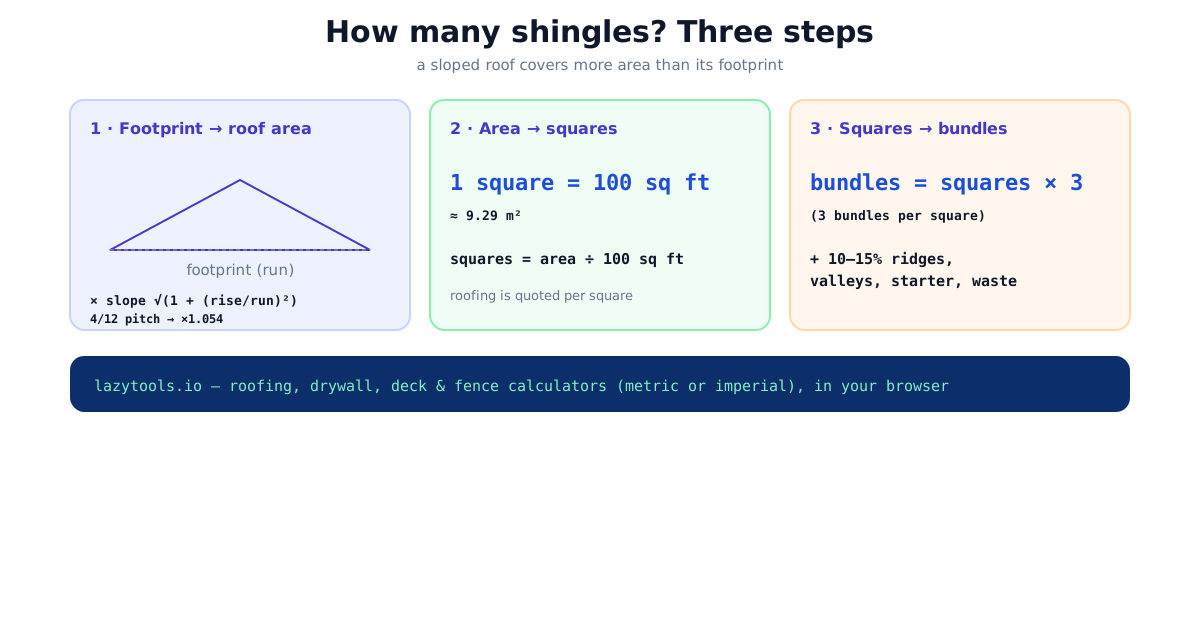
1. Footprint → roof area
Measure the footprint, the ground area under the roof, which is the same as the outline you’d trace on the ground, and multiply by the slope factor:
roof area = footprint × √(1 + (rise/run)²)
The pitch is given as rise over a 12-unit run. A 4/12 roof rises 4 inches per 12 across, giving a slope factor of √(1 + (4/12)²) ≈ 1.054, so it’s about 5% more area than the footprint. Steeper roofs add much more: 12/12 (45°) is √2 ≈ 1.414, a 41% increase. The slope factor is the single most-missed number in a DIY estimate: measure the footprint from the ground, forget to apply it, and you’ll order too few shingles on every roof steeper than flat.
The reason the formula works is plain geometry. A roof plane is the hypotenuse of a right triangle whose base is the horizontal run and whose height is the vertical rise. For every 12 units you travel across, the surface itself travels √(12² + rise²) units up the slope, dividing that by 12 gives the multiplier below. It depends only on the pitch, never on the size of the house.
| Pitch (rise/12) | Angle | Slope factor | Extra area vs footprint |
|---|---|---|---|
| 0/12 (flat) | 0° | 1.000 | 0% |
| 3/12 | ~14° | 1.031 | ~3% |
| 4/12 | ~18° | 1.054 | ~5% |
| 6/12 | ~27° | 1.118 | ~12% |
| 8/12 | ~34° | 1.202 | ~20% |
| 9/12 | ~37° | 1.250 | ~25% |
| 12/12 | 45° | 1.414 | ~41% |
If you can’t safely climb up to measure the pitch, you can estimate it from the ground with a level and a tape, or read it off the building plans. Even eyeballing to the nearest common pitch in the table gets you within a bundle or two on most houses.
2. Roof area → squares
Roofing is sold by the square, where 1 square = 100 sq ft (≈ 9.29 m²). Divide your roof area by 100:
squares = roof area (sq ft) ÷ 100
The square is the trade’s working unit, underlayment, drip edge, nails and labour are all quoted per square, so getting this number right feeds the rest of the estimate, not just the shingle count.
3. Squares → bundles
Standard asphalt shingles come about 3 bundles to a square:
bundles = squares × 3
Heavier or premium shingles may need 4-5 bundles per square, so check the wrapper. Coverage varies by product line, and the number printed on the bundle is the one that counts:
| Shingle type | Typical bundles per square | Notes |
|---|---|---|
| 3-tab asphalt | 3 | The classic budget shingle |
| Architectural (dimensional) | 3 | Thicker but usually still 3/square |
| Heavy/luxury architectural | 4 | More weight per square foot |
| Some premium/designer | 5 | Always confirm on the wrapper |
The roofing calculator runs all three steps and adds your waste allowance, so you don’t have to keep the slope factor and bundle coverage straight by hand.
A worked example: a small shed
A single roof plane over a 12 × 9 ft footprint (108 sq ft) at a 4/12 pitch:
- Roof area = 108 × 1.054 ≈ 113.8 sq ft
- Add 12% waste → ~127.5 sq ft → 1.3 squares
- Bundles = 1.3 × 3 ≈ 4 bundles
Because you round up whole bundles, you’d buy 4 and have some left for the next repair.
A worked example: a whole gable house
A simple, symmetric gable roof has two identical planes. Say the house is 40 ft long and each plane covers a 40 × 18 ft footprint area on the ground, at a 6/12 pitch:
- Footprint of the two planes = 2 × (40 × 18) = 1,440 sq ft
- Roof area = 1,440 × 1.118 ≈ 1,610 sq ft
- Squares = 1,610 ÷ 100 = 16.1 squares
- Add 10% waste → ~17.7 squares
- Bundles = 17.7 × 3 ≈ 53 bundles
Then add separately for the starter course along the eaves and the ridge-cap run along the peak. Those come out of dedicated products or cut from field shingles, not the 53-bundle figure. For a hip roof or a house with dormers, break the roof into rectangles and triangles, area each shape, and sum them before applying the slope factor.
Measuring the footprint
You measure the footprint on the ground, not on the roof, which is what makes this method safe and quick:
- Rectangular houses: length × width of the outline, including the eave overhang.
- L-shaped or complex plans: split into rectangles, measure each, and add. Overlaps get counted once.
- Overhangs: the roof usually extends past the walls, so measure to the edge of the eaves, not to the wall face, otherwise you’ll under-order.
Because the slope factor is applied afterward, you never need to climb up and measure along the incline. The one thing you do need from the roof itself is the pitch, and even that can often be read from plans.
How much to add for waste
Never order exactly the calculated amount:
- Simple gable roof: ~10%.
- Hips and valleys: up to 15%. Those diagonal cuts waste more.
- Complex roofs with many dormers or penetrations: toward the top of that range or a touch beyond.
- Plus starter strips along the eaves and ridge-cap shingles along the top, which aren’t in the field-shingle count.
The waste allowance covers cut-offs, damaged shingles and the odd mistake. It also leaves you a few spare for future repairs in a matching colour lot, running short mid-job means a second trip and possibly a visible colour mismatch if the new batch is dyed differently.
Quick summary
To estimate shingles, multiply the roof footprint by the slope factor √(1 + (rise/run)²) to get the true roof area, divide by 100 sq ft for roofing squares, and multiply by ~3 bundles per square, then add 10-15% for ridges, valleys, starter and waste. Work it out with the roofing calculator, and see the other estimators in the Home & DIY tools.
Sources: standard roofing estimation practice; roofing square = 100 sq ft; typical asphalt-shingle coverage of 3 bundles per square (check the product wrapper for exact coverage). Educational estimate, confirm with a professional for a real order.
Frequently asked questions
How many shingles do I need?
Find the roof area (footprint × slope factor), divide by 100 sq ft to get roofing squares, then multiply by about 3 bundles per square. Add 10-15% for ridges, valleys, starter courses and waste. A 108 sq ft footprint at 4/12 pitch is ~1.3 squares, or about 4 bundles.
What is a roofing square?
A unit of roof area equal to 100 square feet (about 9.29 m²). Roofing materials are quoted per square, and asphalt shingles typically come 3 bundles to a square.
How do I find roof area from the footprint?
Multiply the footprint (ground area under the roof) by the slope factor √(1 + (rise/run)²). A 4/12 pitch has a factor of about 1.054, a 6/12 about 1.118, and a 12/12 (45°) about 1.414.
What is roof pitch?
The steepness, given as rise over a 12-unit run, a 4/12 roof rises 4 inches for every 12 inches horizontal. Steeper pitches produce more roof area for the same footprint, so they need more shingles.
How much extra should I order for a roof?
About 10% for a simple gable roof, and up to 15% for hips and valleys where there are more cuts, plus starter strips and ridge-cap shingles. Running short mid-job means a colour-matched top-up later.
How many bundles are in a square?
For standard 3-tab and most architectural asphalt shingles, 3 bundles cover one square (100 sq ft). Heavier shingles may need 4 or 5 bundles per square, always check the wrapper's stated coverage.