
explainer
Two-Stroke Fuel Mix Ratios Explained (50:1, 40:1, 32:1)
By Uttam Regmi · Published 2026-07-28 · Updated 2026-07-28 · 5 min read · Fact-checked, sources cited
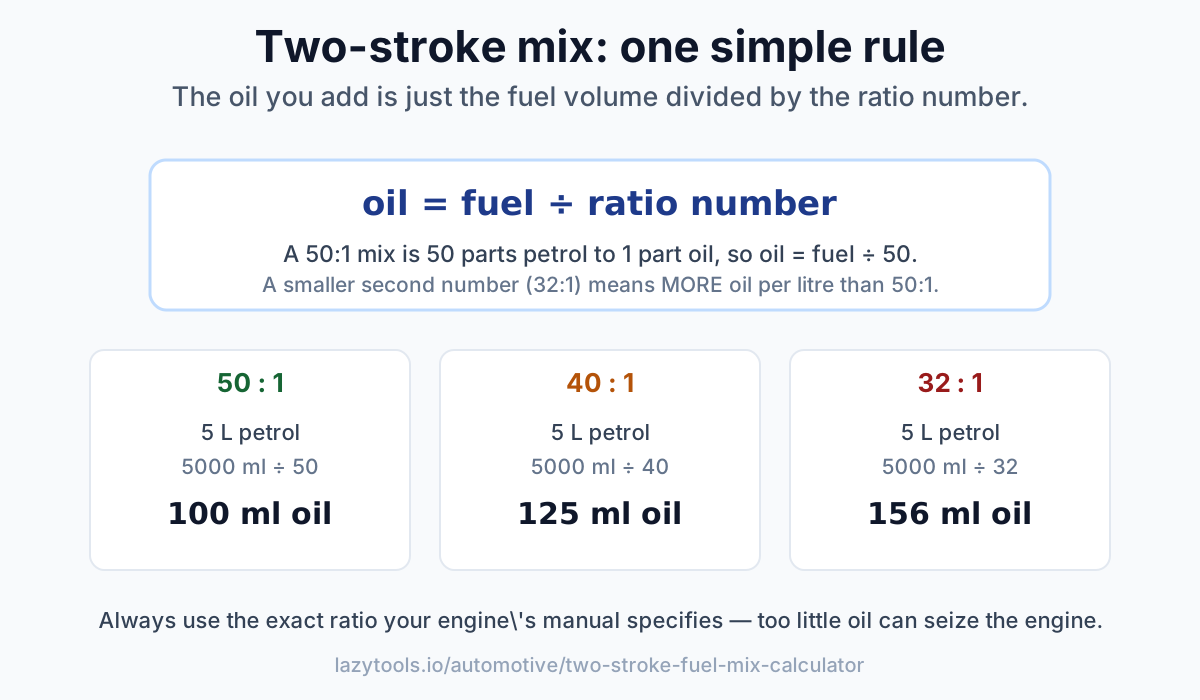
To mix two-stroke fuel, divide the amount of petrol by the ratio number to get how much oil to add. A 50:1 mix means 50 parts petrol to 1 part oil, so for 5 litres of petrol you add 5000 ml ÷ 50 = 100 ml of oil. A 40:1 mix needs 125 ml, and a 32:1 mix needs 156 ml for the same 5 litres, the smaller the second number, the more oil per litre. Always use the exact ratio your engine’s manufacturer specifies.
What the ratio actually means
A two-stroke (or “two-cycle”) engine has no separate oil sump, it’s lubricated by oil mixed into the petrol. The mix ratio is written as fuel : oil. So:
- 50:1 = 50 parts petrol to 1 part oil
- 40:1 = 40 parts petrol to 1 part oil
- 32:1 = 32 parts petrol to 1 part oil
The lower the second-number ratio (32:1 vs 50:1), the more oil goes in per litre of fuel. That trips people up: 32:1 sounds “smaller” but it’s actually a richer, oilier mix than 50:1.
Because a two-stroke fires on every crankshaft revolution and draws its fuel/air charge through the crankcase, the oil suspended in the petrol is what coats the crank bearings, piston skirt and cylinder wall before it burns. There is no dipstick and no oil filter to fall back on, the ratio you pour is the only lubrication the engine gets. That is why the number matters far more than on a four-stroke, and why “close enough” is not a safe attitude when measuring.
The formula
To find the oil for any amount of fuel:
oil = fuel volume ÷ ratio number
Convert the fuel to millilitres first (or use the two-stroke fuel mix calculator to do it instantly in ml and fluid ounces):
- 1 litre at 50:1 → 1000 ÷ 50 = 20 ml of oil
- 5 litres at 50:1 → 5000 ÷ 50 = 100 ml
- 1 US gallon at 50:1 → 3785 ÷ 50 = ≈ 76 ml (about 2.6 fl oz)
Quick mixing chart (oil per amount of petrol)
| Ratio | Per 1 litre | Per 5 litres | Per 1 US gallon |
|---|---|---|---|
| 50:1 | 20 ml | 100 ml | ≈ 2.6 fl oz |
| 40:1 | 25 ml | 125 ml | ≈ 3.2 fl oz |
| 32:1 | 31 ml | 156 ml | ≈ 4.0 fl oz |
| 25:1 | 40 ml | 200 ml | ≈ 5.1 fl oz |
| 16:1 | 63 ml | 313 ml | ≈ 8.0 fl oz |
A worked example, start to finish
Say your chainsaw manual specifies 50:1 and you want to fill a 2-litre fuel can:
- Convert the fuel to millilitres: 2 litres = 2000 ml.
- Divide by the ratio number: 2000 ÷ 50 = 40 ml of oil.
- Pour roughly half the petrol into a clean, approved fuel can.
- Add the measured 40 ml of two-stroke oil.
- Top up with the rest of the petrol, cap the can, and shake it for 10-15 seconds so the oil disperses evenly.
If the same saw called for 40:1 instead, you would need 2000 ÷ 40 = 50 ml, just 10 ml more, but skipping it leaves the mix noticeably lean. That small margin is exactly why measuring by eye is a bad idea: a 10 ml error on a 2-litre batch shifts you a whole ratio band.
For odd container sizes, awkward gallons, or a straight ml-and-fluid-ounce readout, the two-stroke fuel mix calculator does the arithmetic for you and removes the rounding guesswork.
Which ratio should you use?
Whatever your engine’s manufacturer specifies, never guess. The correct ratio is in the owner’s manual and often printed on the fuel cap or housing. Common cases:
- Modern chainsaws, string trimmers and leaf blowers: often 50:1 or 40:1.
- Older or air-cooled two-strokes and some outboards: often 32:1 or richer.
- When a range or “up to” is given, the richer (more oil) end suits heavy, hot or wide-open-throttle running.
Getting it wrong is expensive: too little oil is the fast route to a seized piston, while far too much causes heavy smoke, plug fouling and carbon build-up.
Choosing the right two-stroke oil
The ratio is only half the job, the oil itself has to match the engine. Air-cooled garden and power equipment is rated under the Japanese JASO standard, while water-cooled marine outboards use the American NMMA TC-W3 standard. They are not interchangeable, and the higher grades are formulated to burn cleaner and leave less deposit.
| Oil grade | Typical use | Notes |
|---|---|---|
| JASO FB | Older/basic air-cooled tools | Minimum performance; more smoke and deposits |
| JASO FC / FD | Modern chainsaws, trimmers, blowers | Low-smoke, low-deposit; FD is the cleanest-burning JASO grade |
| TC-W3 (NMMA) | Water-cooled marine outboards | Formulated for marine engines; do not use in air-cooled tools |
| Car engine oil | None | Not designed to burn in the combustion chamber, will foul and damage |
When in doubt, match the grade named in your manual. A modern low-smoke synthetic in the correct JASO or TC-W3 grade is a safe default for the equipment it is designed for.
Mixing tips that matter
- Use fresh petrol, two-stroke mix goes stale in weeks; ethanol-blended fuel degrades faster. Mix only what you’ll use in a month.
- Use a proper two-stroke oil rated for your engine (look for JASO FD for air-cooled equipment, or TC-W3 for water-cooled marine engines).
- Measure the oil accurately and pour it into the fuel, then shake or swirl the container to combine before filling the tank.
- Label the can with the ratio so you don’t accidentally run straight petrol or the wrong mix.
Frequently asked questions
How much oil do I add for a 50:1 two-stroke mix?
Divide the petrol volume by 50. That works out to 20 ml of oil per litre, 100 ml per 5 litres, or about 2.6 fl oz per US gallon.
Is a 40:1 mix more oil than 50:1?
Yes. 40:1 uses 25 ml of oil per litre versus 20 ml at 50:1. The lower the second number, the more oil per litre, so 32:1 is richer still at about 31 ml per litre.
What happens if I put too much oil in two-stroke fuel?
The engine smokes heavily, the spark plug fouls, and carbon builds up on the piston and exhaust port. It runs poorly, but a slightly oil-rich mix rarely causes immediate damage, unlike too little oil.
What happens if there is not enough oil in the mix?
The engine loses lubrication and can overheat and seize, often ruining the piston and cylinder. This is the dangerous mistake, which is why you should never run straight petrol or a too-lean mix.
Can I use car engine oil in two-stroke fuel?
No. Use oil formulated specifically for two-stroke engines. Regular motor oil does not burn cleanly in the combustion chamber and will not lubricate correctly, risking damage.
How long does mixed two-stroke fuel last?
Use it within about 30 days. Mixed fuel, especially with ethanol-blended petrol, degrades and can gum up the carburettor. Mix small batches and store fuel in a sealed, approved container out of sunlight.