
explainer
Voltage Drop Explained (and How to Keep It Under 3%)
By Uttam Regmi · Published 2026-07-28 · Updated 2026-08-23 · 6 min read · Fact-checked, sources cited
Voltage drop is the voltage lost to a wire’s resistance over the run, and it equals the current times the wire’s resistance times the total conductor length, for DC and single-phase that’s 2 × current × resistance-per-metre × the one-way length (use √3 instead of 2 for three-phase). The US National Electrical Code recommends keeping it under 3% on a branch circuit. Excess drop dims lights, slows motors and wastes energy as heat.
Why voltage drops
No conductor is perfect: every wire has a small resistance, and pushing current through a resistance loses some voltage (Ohm’s law, V = I × R). Over a short run it’s negligible, but over a long cable carrying significant current, the loss adds up, and it’s paid twice, because the current has to travel out to the load and back.
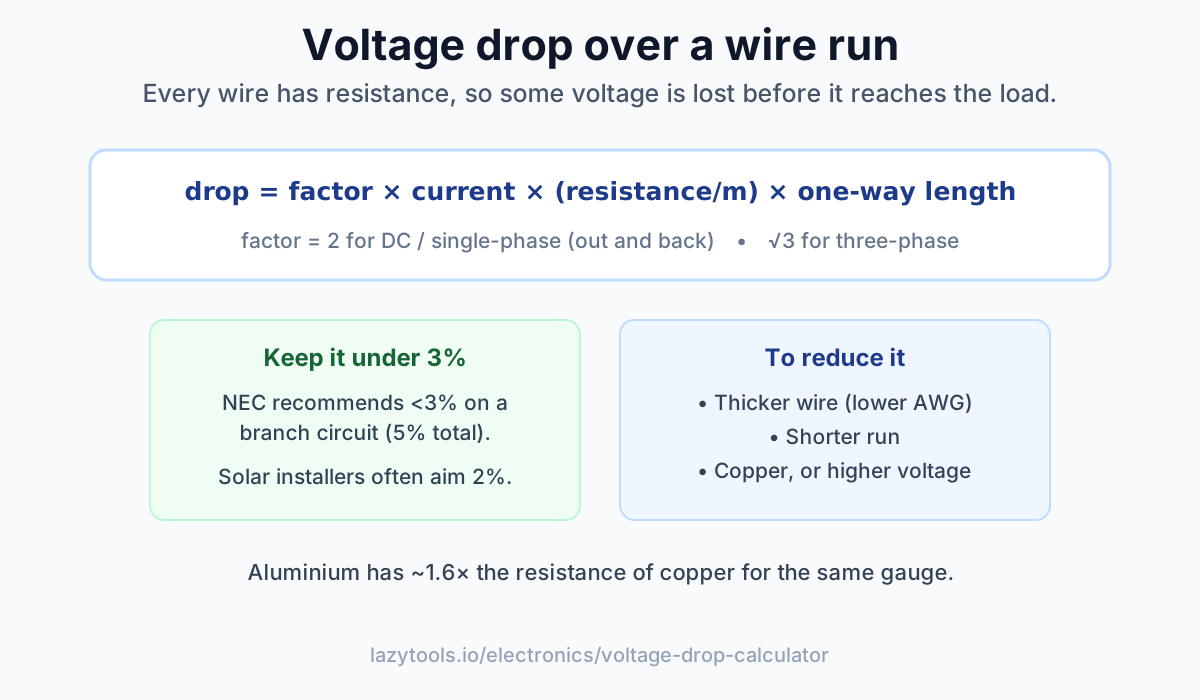
That’s the factor of 2 in the single-phase and DC formula (out and back along both conductors). Three-phase systems share the return across phases, so they use √3 instead.
drop (V) = factor × current (A) × resistance-per-metre (Ω/m) × one-way length (m)
The resistance-per-metre depends on the wire gauge (thicker wire = lower resistance) and the material (aluminium is worse than copper). The voltage drop calculator looks up the resistance for your AWG, applies the right factor for DC, single- or three-phase, and shows the drop in volts, as a percentage, and the voltage that actually reaches the load.
Wire resistance by gauge
The resistance-per-metre is the number that turns the formula into a real answer. In the American Wire Gauge (AWG) system, a smaller number means a thicker wire, and every 3-gauge step roughly doubles or halves the cross-sectional area, so it roughly halves or doubles the resistance. The values below are approximate DC resistances for solid, uncoated copper at around 20 °C; aluminium of the same gauge runs about 1.6× higher.
| Wire size (AWG) | Copper resistance (Ω per km) | Copper resistance (Ω per 1000 ft) | Typical use |
|---|---|---|---|
| 14 | ~8.3 | ~2.5 | 15 A lighting/receptacle circuits |
| 12 | ~5.2 | ~1.6 | 20 A general-purpose circuits |
| 10 | ~3.3 | ~1.0 | 30 A dryers, water heaters |
| 8 | ~2.1 | ~0.63 | 40-50 A ranges, sub-feeds |
| 6 | ~1.3 | ~0.40 | 55-65 A feeders, EV chargers |
Treat these as guide figures for estimating drop, not as ampacity ratings. The exact resistance shifts with temperature (hotter wire has more resistance), with stranding, and with tinned versus bare copper, which is why a good voltage drop calculator and your local code tables are the right authority for a real install.
The 3% rule
The National Electrical Code (NEC), published by the NFPA, recommends:
- ≤ 3% voltage drop on a branch circuit, and
- ≤ 5% total including the feeder.
Strictly speaking, these are recommendations carried in the NEC’s informational notes, not hard rules the code enforces, but most designers and inspectors treat them as the practical target because they keep equipment inside its rated operating window. Many solar and low-voltage DC designers go tighter and target 2% or less, because low-voltage systems feel a given voltage loss more (a 1 V drop is a big deal at 12 V, trivial at 240 V). Excess drop causes real problems: dim or flickering lights, motors and compressors that run hot and struggle to start, sensitive electronics misbehaving, and energy simply wasted as heat in the cable.
A worked example
Suppose you run a 20 A, 120 V single-phase circuit 30 m (about 100 ft) one way in 10 AWG copper. Using ~3.3 Ω/km, the resistance-per-metre is 0.0033 Ω/m:
drop = 2 × 20 A × 0.0033 Ω/m × 30 m ≈ 3.9 V
That is 3.9 V ÷ 120 V ≈ 3.3%, just over the 3% target, and only 116 V actually reaches the load. Step up one common size to 8 AWG (~2.1 Ω/km, 0.0021 Ω/m) and the same run drops to about 2.5 V, or 2.1%, comfortably inside the limit. This is the single most common real-world fix: the current, length and voltage are fixed by the job, so you buy back margin with a thicker conductor.
For a three-phase contrast, take 30 A at 400 V over 50 m of 6 AWG copper (0.0013 Ω/m). Because three-phase uses the √3 factor:
drop = 1.732 × 30 A × 0.0013 Ω/m × 50 m ≈ 3.4 V (about 0.8%)
Notice how much healthier three-phase looks: higher voltage plus the √3 factor keeps the percentage tiny even over a long run. That is why long, high-current distribution is so often done at higher voltages.
How to reduce voltage drop
If your run exceeds the limit, you have four levers:
- Use a thicker wire (a lower AWG number). Roughly doubling the cross-sectional area halves the drop, the most common fix.
- Shorten the run where you can, or move the source closer to the load.
- Use copper instead of aluminium, copper has ~1.6× less resistance for the same gauge.
- Raise the system voltage if the design allows, since the same watts at a higher voltage means less current and less drop.
Voltage drop is not the same as ampacity
A wire has two separate size limits, and it is easy to confuse them. Ampacity is how much current the conductor can carry before it overheats, a safety limit set by insulation temperature ratings. Voltage drop is a performance limit about how much voltage survives the trip. A conductor can be perfectly safe on ampacity yet still drop too much voltage on a long run, which is exactly why a 30 m branch circuit sometimes needs a wire larger than the breaker alone would suggest. Always size for the stricter of the two: pick the gauge that satisfies ampacity and keeps drop under your target.
The dropped voltage also has a real energy cost. The voltage lost across the cable, multiplied by the current, is power dissipated as heat (P = drop × current, equivalently I²R). In the first worked example above, 3.9 V across 20 A is roughly 78 W turned into heat in the wire, energy you pay for but never use. Cutting voltage drop cuts that waste at the same time.
This is a design aid. Always follow your local electrical code and use a licensed electrician for real installations.
Frequently asked questions
What is voltage drop?
Voltage drop is the voltage lost to a wire's resistance over the length of the run. Pushing current through a resistance loses some voltage (Ohm's law, V = I × R), so over a long cable carrying significant current the loss adds up.
What is the formula for voltage drop?
drop = factor × current × resistance-per-metre × one-way length. The factor is 2 for DC and single-phase (the current travels out and back along both conductors) and √3 for three-phase, which shares the return across phases.
How much voltage drop is acceptable?
The US National Electrical Code recommends keeping voltage drop under 3% on a branch circuit, and under 5% total including the feeder. Solar installations often target a tighter 2%.
How do I reduce excessive voltage drop?
Use a thicker wire (a lower AWG number), shorten the run, switch from aluminium to copper, or use a higher supply voltage. Long runs and high current are the two things that push voltage drop up fastest.
Does aluminium wire drop more voltage than copper?
Yes. Aluminium has about 1.6 times the resistance of copper for the same gauge, so an aluminium conductor drops more voltage than a copper one of the same size over the same run.