
how-to
What Size Air Conditioner Do I Need? (BTU)
By Uttam Regmi · Published 2026-07-28 · Updated 2026-07-28 · 5 min read · Fact-checked, sources cited
To size an air conditioner, start at roughly 20 BTU/h per square foot of floor area, then adjust for sun, people and heat sources. That single rule answers “what size air conditioner do I need?” for most single rooms: measure the floor, multiply by 20, and you have a baseline in BTU per hour. A 300 sq ft bedroom lands near 6,000 BTU/h before any tweaks.
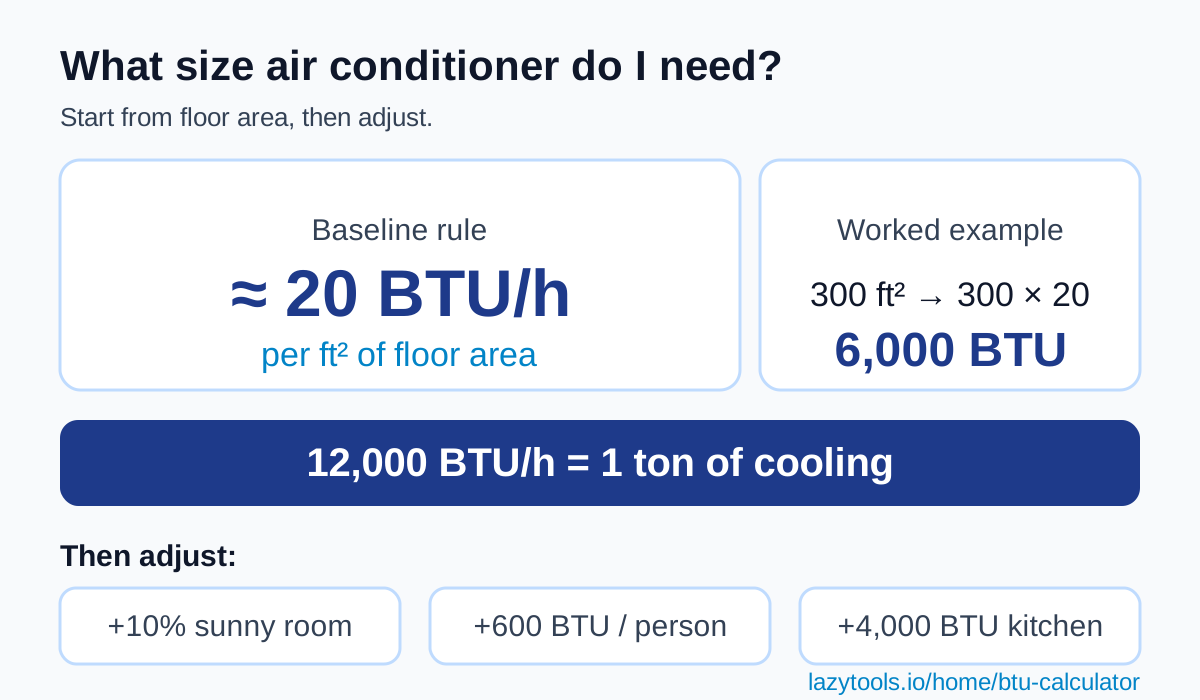
The 20 BTU per square foot rule
The ENERGY STAR, “How To Choose the Right Sized Window AC” guideline is about 20 BTU per hour for every square foot of floor area. Measure the room (length × width in feet), multiply by 20, and you have a starting capacity:
baseline BTU/h = floor area (ft²) × 20
Here is what that rule gives across common room sizes, all computed straight from 20 BTU/ft²:
| Room size | Baseline capacity |
|---|---|
| 150 ft² | 3,000 BTU/h |
| 250 ft² | 5,000 BTU/h |
| 300 ft² | 6,000 BTU/h |
| 400 ft² | 8,000 BTU/h |
| 550 ft² | 11,000 BTU/h |
| 700 ft² | 14,000 BTU/h |
To measure, take the length and width in feet and multiply them; for an L-shaped or irregular room, split it into rectangles, size each one, and add the results. The rule assumes standard ceilings of roughly eight feet, noticeably higher ceilings mean more air to cool, which is one of the cases where a simple per-square-foot estimate starts to understate the load.
Treat these numbers as the honest midpoint, not the final answer. The BTU calculator does the multiplication and then layers on the adjustments below so you don’t have to keep a running total in your head.
Adjust for sun, people and kitchens
A bare per-square-foot number assumes an average room. Real rooms gain or lose heat, so nudge the baseline:
- Very sunny room: add 10%. South- and west-facing rooms with big windows soak up afternoon heat.
- Heavily shaded room: subtract 10%. A shaded, north-facing room needs less.
- Extra occupants: add 600 BTU for each regular occupant beyond two. People are little heaters, two are already baked into the baseline.
- Kitchen: add 4,000 BTU to cover the heat thrown off by the stove, oven and refrigerator.
So a 300 ft² kitchen that gets strong sun starts at 6,000, gains 10% (to 6,600), then adds 4,000 for the appliances, about 10,600 BTU/h. The same-size shaded bedroom drops the other way.
Why bigger is not better
It is tempting to round up “to be safe.” Don’t. An oversized air conditioner cools the air fast, then shuts off, a pattern called short-cycling.
Two things go wrong. First, humidity: an AC pulls moisture out of the air only while it runs, and a unit that blasts cold then quits doesn’t run long enough to dehumidify. The room ends up cold but clammy. Second, those rapid on/off cycles waste energy and wear the compressor, the most expensive part to replace.
A right-sized unit runs in longer, steadier cycles, which is exactly what keeps a room both cool and dry. Match the capacity to the room instead of over-buying. If your calculated load falls between two available sizes, a small step up is fine, but resist jumping to the next tier “just in case”: the adjustments for sun, people and kitchen heat already build in the headroom you actually need.
BTU, tons and watts
Capacity gets quoted in a few different units, but they all describe the same thing:
- 1 ton of cooling = 12,000 BTU/h. So 24,000 BTU/h is 2 tons. (The “ton” is a historical unit tied to the cooling power of a ton of melting ice. It has nothing to do with the unit’s weight.)
- Watts are the metric equivalent, handy if your spec sheet is in kilowatts.
Window and portable units are usually labelled in BTU/h; central and mini-split systems often in tons. The BTU calculator can show your result in whichever unit you need, so you can shop across both.
Common mistakes
- Oversizing “to be safe.” The single biggest error. It trades comfort for a clammy, short-cycling room. Size to the actual load.
- Ignoring sun and kitchen heat. A sunny west-facing room or a kitchen can need thousands of BTU more than its floor area alone suggests.
- Using a single-room rule for a whole house. Per-square-foot math is fine for one room. A whole house, high ceilings, or a ducted system needs a proper Manual J heat-load calculation, the professional method that accounts for insulation, window area and local climate.
- Confusing BTU with tons. They measure the same thing at different scales (12,000 BTU/h = 1 ton). Mixing them up leads to ordering a unit ten times too big or too small.
Size it in a few seconds
For a single room, the arithmetic is quick: floor area × 20 BTU/h, then adjust for sun, occupants and any kitchen heat. Rather than track the running total yourself, punch the numbers into the BTU / AC sizing calculator. It applies every adjustment and shows the result in BTU, tons and watts, entirely in your browser with nothing uploaded. For material take-offs and other project math, browse the rest of the Home & DIY tools or see our guide to estimating materials.
Sources: ENERGY STAR room air conditioner sizing guidance (≈20 BTU/h per square foot) and standard HVAC practice; whole-house sizing follows an ACCA Manual J heat-load calculation. Educational estimates for a single room, not a substitute for a professional load calculation on a full system.
Frequently asked questions
How many BTU to cool a room?
As a baseline, use about 20 BTU per hour per square foot of floor area. So a 300 sq ft room needs roughly 300 × 20 = 6,000 BTU/h. Then adjust up for a very sunny room or a kitchen, and down for heavy shade.
How do you calculate AC size?
Measure the room's floor area (length × width), multiply by about 20 BTU/h per square foot, then apply adjustments: +10% for a very sunny room, −10% for heavy shade, +600 BTU for each regular occupant beyond two, and +4,000 BTU if it's a kitchen. Our BTU calculator does the arithmetic for you.
What size AC for a 300 sq ft room?
At 20 BTU/h per square foot, a 300 sq ft room needs about 6,000 BTU/h as a baseline. Add roughly 10% if it gets strong afternoon sun, or add 4,000 BTU if it doubles as a kitchen.
Is a bigger BTU air conditioner better?
No. An oversized AC cools the air quickly but short-cycles, so it removes less humidity and leaves the room cold and clammy. Short-cycling also wastes energy and wears the compressor. Match capacity to the room instead of over-buying.
How many BTU is a ton of cooling?
One ton of cooling equals 12,000 BTU/h. So a 24,000 BTU/h unit is 2 tons. Results can also be expressed in watts if you prefer metric units.
When do I need a professional Manual J calculation?
A per-square-foot rule is a quick single-room estimate. For a whole house, high ceilings, or a ducted system, use a proper Manual J heat-load calculation. It accounts for insulation, windows and climate that a simple rule ignores.