
explainer
How to Calculate BMI and What It Means
By Uttam Regmi · Published 2026-07-28 · Updated 2026-07-28 · 6 min read · Fact-checked, sources cited
BMI (body mass index) is your weight in kilograms divided by your height in metres squared, for someone who is 70 kg and 1.75 m tall, that is 70 ÷ 1.75² = 22.9. It is a quick way to see whether your weight sits in a range the World Health Organization (WHO) considers healthy for adults, and it takes two numbers you already know. Run your own figures in the BMI calculator, everything below explains how the number is built and, just as important, what it can and cannot tell you.
How BMI works, in one picture
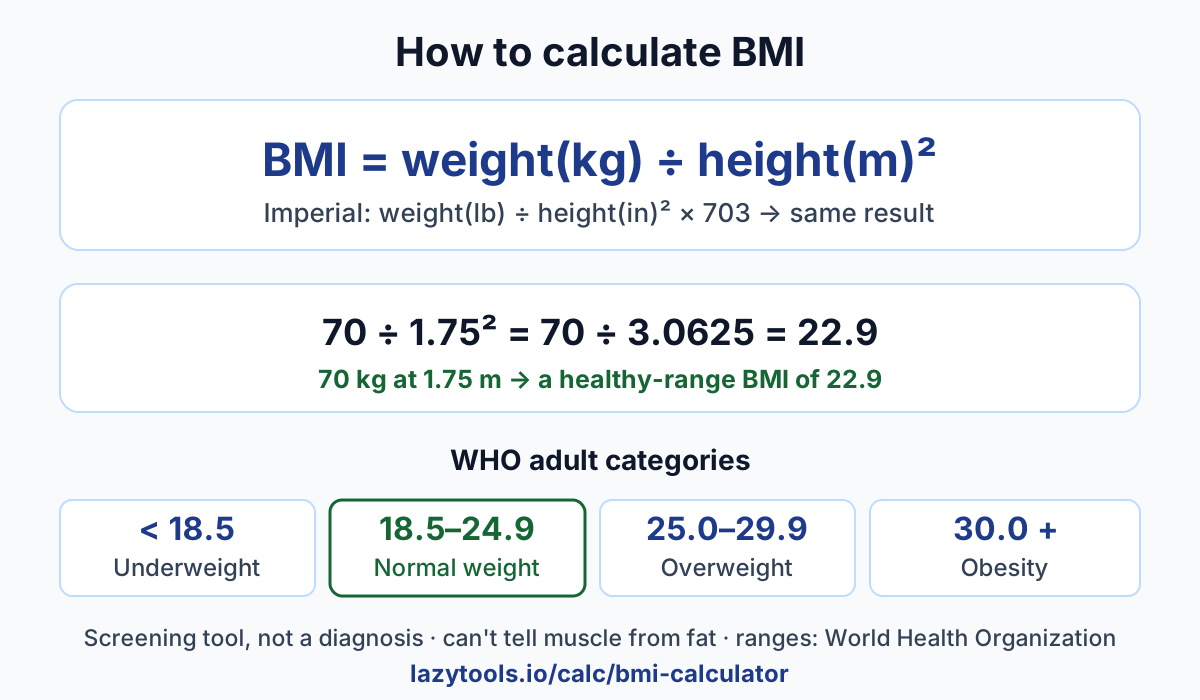
The BMI formula, worked in metric and imperial
BMI takes two measurements and combines them into one number, and both unit systems land on the same value. In metric you divide weight in kilograms by height in metres, squared:
- Metric: BMI = weight(kg) ÷ height(m)²
For a person of 70 kg standing 1.75 m tall, square the height first, 1.75 × 1.75 = 3.0625, then divide: 70 ÷ 3.0625 = 22.9. That places them comfortably inside the healthy band.
If you think in pounds and inches, the same logic applies with a conversion factor of 703:
- Imperial: BMI = weight(lb) ÷ height(in)² × 703
The 703 rescales pounds-and-inches into the kilograms-and-metres world, so a body that reads 22.9 in metric reads 22.9 in imperial too. The BMI calculator handles either set of units and the squaring for you.
Why square the height at all? Because weight scales roughly with volume, and dividing by height squared is the simple correction that stops tall and short people of similar build getting wildly different scores. It is an approximation, very tall people can be slightly over-flagged and very short people slightly under-flagged, but for most adults it works well enough to be the standard the whole world uses.
What your BMI category means
Your BMI falls into one of four adult categories defined by the WHO, and each is a band rather than a single line. Here is the full chart for adults:
| BMI range | WHO category |
|---|---|
| Under 18.5 | Underweight |
| 18.5-24.9 | Normal (healthy) weight |
| 25.0-29.9 | Overweight |
| 30.0 and above | Obesity |
These ranges are set by the World Health Organization and apply to adult men and women alike, the numbers are not sex-specific. A BMI of 22.9, as in our example, sits near the middle of the healthy band. A reading of 26 lands in the overweight range, and 31 in the obesity range.
Treat the boundaries as soft edges, not cliffs. The difference between 24.9 and 25.1 is a rounding artefact, not a meaningful change in your health. What the categories give you is a rough sense of direction, whether it is worth looking more closely, not a precise score.
To make the bands concrete, take three people who are all 1.70 m tall. At 55 kg the BMI is 19.0 (healthy); at 74 kg it is 25.6 (overweight); at 88 kg it is 30.4 (obesity). The same height, three different categories, and the only thing that moved was weight. That is exactly what BMI is designed to surface, how your weight compares to your height, and exactly the point at which its blindness to what that weight is made of starts to matter.
Why BMI misleads for athletes and older adults
BMI’s biggest weakness is that it only sees height and weight, so it cannot distinguish muscle from fat. Muscle is denser than fat, which means a strong, lean person carries more weight for their height and can score in the overweight range (25+) while having very little body fat. Sprinters, rowers and many gym regulars routinely trip this wire.
The same blind spot works in reverse. Someone with low muscle mass, which becomes more common with age, can carry more fat than their BMI suggests and still read as “normal.” That is why BMI can under-flag exactly the people a screen is meant to catch.
For an individual, better signals are waist circumference and body-fat percentage, which speak to where and how much fat you actually carry. Waist size in particular tracks the fat stored around your organs, which is the kind most tied to health risk, two people with an identical BMI can have very different waist measurements and very different risk. BMI earns its keep as a fast, cheap measure across large populations, not as the last word on any one body. It is also not validated the same way for children, who are assessed against age- and sex-specific percentiles rather than these fixed adult cut-offs.
Common mistakes
A handful of slips account for most wrong BMI numbers:
- Mixing centimetres and metres. The metric formula needs height in metres, so 175 cm is 1.75 m. Plugging in 175 as if it were metres produces a nonsensically tiny BMI. Divide centimetres by 100 first.
- Forgetting the ×703 in imperial. Weight in pounds over height in inches squared without the 703 factor gives a number far too small. The 703 is not optional. It is what makes imperial and metric agree.
- Treating BMI as a diagnosis. A single number cannot diagnose anything. BMI screens; it does not conclude. Use it to decide whether to look further, then let a clinician interpret the fuller picture.
- Using adult cut-offs for kids. Children and teenagers are assessed on growth percentiles for their age and sex, not the 18.5/25/30 adult bands. Applying adult thresholds to a child is simply the wrong tool.
Get those four things right and your BMI will be correct to the decimal. What it means is a separate question, and one the number alone was never designed to answer.
Check your BMI privately
You can find your BMI in seconds, and your height and weight never leave your device. The BMI calculator runs entirely in your browser, nothing is uploaded, logged or sent to a server, so you can enter your real numbers without a second thought. If you want to go further into daily energy needs, pair it with the TDEE calorie calculator for your maintenance calories, and read the calorie-needs explainer for how those figures fit together.
One honest caveat to close on: BMI is a screening tool, not a diagnosis, and it cannot tell muscle from fat or account for your individual health. This article is general information, not medical advice, for any decision about your weight or health, talk to a qualified clinician.
Source: World Health Organization, Body mass index (BMI) and the healthy weight ranges for adults. General information only, not medical advice.
Frequently asked questions
What is a healthy BMI?
The World Health Organization (WHO) puts the healthy (normal) weight range for adults at a BMI of 18.5 to 24.9. Below 18.5 is classed as underweight, 25.0 to 29.9 as overweight, and 30.0 or above as obesity. These are population screening bands, not a personal verdict, a fit, muscular person can sit above 24.9 without carrying excess fat.
How do you calculate BMI?
Divide your weight in kilograms by your height in metres squared: BMI = weight(kg) ÷ height(m)². For example, 70 kg at 1.75 m is 70 ÷ (1.75 × 1.75) = 70 ÷ 3.0625 = 22.9. In imperial units the formula is weight(lb) ÷ height(in)² × 703, and it gives the same number.
Is BMI accurate for athletes or muscular people?
Not for individuals. BMI only knows your height and weight, so it cannot tell muscle from fat. Muscle is denser than fat, so athletic and heavily trained people often read as overweight (25+) while being lean. BMI can also under-flag people with low muscle mass who carry more fat than the number suggests. Waist circumference and body-fat percentage are better individual signals.
Does the BMI formula differ for imperial units?
The idea is identical; only the arithmetic changes. Metric is weight(kg) ÷ height(m)². Imperial is weight(lb) ÷ height(in)² × 703, the 703 factor converts pounds and inches into the same scale as kilograms and metres. Both routes give the same BMI, so use whichever units you already have.
Is BMI different for men and women?
The BMI formula and the WHO cut-offs are the same for adult men and women, BMI itself is not sex-specific. Body composition does differ between sexes on average, which is one reason BMI is a rough screen rather than a precise measure of fatness, but there is no separate men's or women's formula for adults.
Is BMI a diagnosis?
No. BMI is a screening tool, not a diagnosis. It flags whether your weight-for-height is in a range worth a closer look, but it says nothing on its own about your health. A clinician interprets it alongside waist measurement, blood work, activity and history. This article is general information, not medical advice.