
explainer
What Is a Good Engagement Rate? (By Platform & Size)
By Uttam Regmi · Published 2026-10-28 · Updated 2026-10-28 · 6 min read · Fact-checked, sources cited
A good engagement rate is roughly 1 to 3% on most platforms, with anything above 3% considered strong and above 6% excellent. Engagement rate measures how many people actually interact with your content relative to your audience size, and it usually matters more to brands than raw follower count. The catch is that “good” depends on platform, niche and how large your account is: small accounts routinely post higher percentages than mega-accounts, so the right comparison is always against similar accounts on the same platform. Work out yours in seconds with the Engagement Rate Calculator.
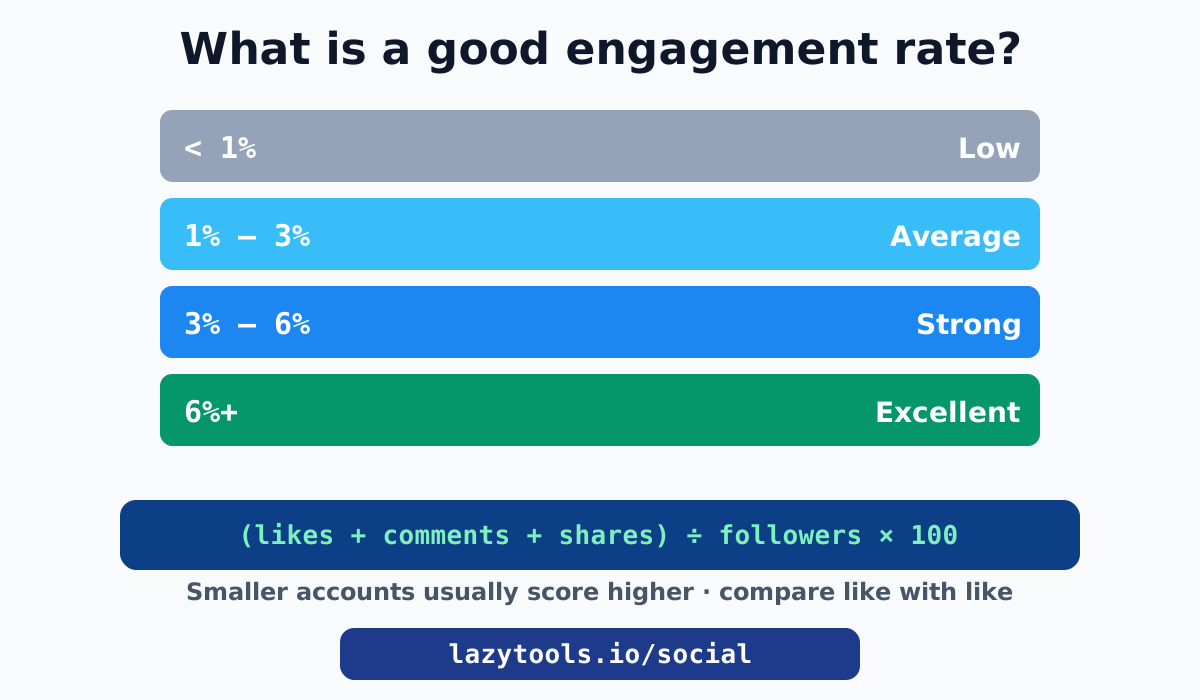
How engagement rate is calculated
Engagement rate turns your interactions into a percentage of your audience. The most widely used formula is:
Engagement rate = (likes + comments + shares + saves) ÷ followers × 100
So an account with 25,000 followers whose post earned 1,200 likes, 85 comments and 40 shares has an engagement rate of (1,200 + 85 + 40) ÷ 25,000 × 100 = 5.3%. The calculator does this instantly and tells you which band you land in.
There is one important variation. Instead of dividing by followers, you can divide by reach or impressions (the number of people who actually saw the post). Engagement rate by reach is almost always higher, because reach is usually smaller than your total follower count. Neither is “more correct”; they answer different questions. Engagement by followers measures loyalty of your audience; engagement by reach measures how compelling a specific post was to the people it reached. Just pick one and be consistent.
What counts as a good engagement rate
There is no single official benchmark, because every platform, niche and audience behaves differently. But these commonly cited bands are a reasonable rule of thumb across platforms:
| Engagement rate | Rating |
|---|---|
| Under 1% | Low |
| 1% to 3% | Average |
| 3% to 6% | Strong |
| Above 6% | Excellent |
Treat these as a starting point, not a verdict. A 2% rate might be excellent for a million-follower account and mediocre for a 2,000-follower one. Always benchmark against accounts of a similar size on the same platform, and against your own history, which is the comparison that actually tells you whether you are improving.
It varies a lot by platform
Different platforms surface and reward interaction differently, so typical engagement rates differ:
- Instagram rewards saves and shares heavily, and formats matter: carousels and Reels tend to engage more than a single image. Solid rates for larger accounts often sit in the low single digits.
- TikTok can produce very high engagement because the For You feed pushes content to interested viewers regardless of follower count, so even small accounts sometimes post high rates on a hit video.
- X (Twitter) and Facebook generally show lower engagement rates than Instagram or TikTok for comparable accounts, partly because of how their feeds and link-sharing work.
- LinkedIn engagement is lower in raw percentage but can be more valuable per interaction for business audiences.
Because the numbers shift between platforms and change as algorithms evolve, the safest approach is to compare within one platform and track your own trend over time rather than chasing a cross-platform ideal.
Why smaller accounts score higher
It surprises people that a creator with 5,000 followers often has a higher engagement rate than one with 500,000. Two things drive it:
- A tighter community. Smaller audiences are usually more interested and more connected to the creator, so a larger share of them likes, comments and shares.
- The maths of large numbers. As an account grows, it accumulates passive followers, people who followed once and rarely engage. They stay in the denominator (followers) without adding to the numerator (interactions), pulling the percentage down even as total engagement climbs.
This is exactly why brands increasingly court micro-influencers (roughly 10,000 to 100,000 followers): their higher engagement rates often convert better per follower than a celebrity account with millions of passive fans. If you are pricing sponsorships, a strong engagement rate is a genuine bargaining chip, factor it in with the influencer rate calculator.
Why engagement rate beats follower count
A big following looks impressive, but it can hide a quiet audience. Follower counts can be inflated by inactive accounts, old follows and, in the worst cases, purchased followers. None of those people respond to your content, yet they all sit in your follower total.
Engagement rate cuts through that. It shows the share of your audience that actually does something when you post, which is a far better predictor of reach (platforms promote content that engages), trust, and conversions. That is why a savvy brand reviewing a creator looks past the headline follower number and straight at the engagement rate, and why it is the single metric most worth improving.
How to improve your engagement rate
Engagement rate rises when you give a specific audience content they genuinely care about and make it easy to interact:
- Know your audience and post for them, not for everyone. A focused account that serves one community well out-engages a broad one.
- Invite interaction. Ask questions, run polls, and use formats that pull people in (carousels, Reels, short video). Reply to comments quickly, early engagement signals the algorithm to show the post to more people.
- Post when your audience is active, so your content lands while people are there to react.
- Prune dead weight. Removing fake or inactive followers lowers your denominator and raises your true engagement rate, and gives you a cleaner picture of who is really listening.
- Prioritise quality over frequency. Fewer, stronger posts usually beat a flood of filler that trains your audience to scroll past.
Small, consistent improvements compound. Track your rate after each change with the calculator and watch the trend rather than any single post.
Measure yours
A good engagement rate is roughly 1 to 3% as a baseline, with 3%-plus strong and 6%-plus excellent, but the number only means something next to accounts of similar size on the same platform and next to your own history. Remember that engagement rate, not follower count, is what reveals a real, responsive audience.
Calculate yours now with the Engagement Rate Calculator, then use the rest of the social and creator toolkit, including the follower growth calculator and the influencer rate calculator, to set goals and price your work with real numbers.
Benchmark ranges are widely-cited industry rules of thumb that vary by platform, niche and the report you consult; treat them as guidance and prioritise comparison against similar accounts and your own trend.
Frequently asked questions
What is a good engagement rate?
As a general guide, under 1% is low, 1 to 3% is average, 3 to 6% is strong, and above 6% is excellent. The benchmark varies by platform, niche and follower count, so compare against accounts of similar size on the same platform rather than a single universal number.
How do you calculate engagement rate?
The most common formula is (likes + comments + shares + saves) ÷ followers × 100, giving a percentage. Some people divide by reach or impressions instead of followers, which usually produces a higher number because reach is smaller than total followers.
What is a good engagement rate on Instagram?
Commonly cited ranges put a solid Instagram engagement rate around 1 to 3% for larger accounts, with smaller accounts often seeing higher. Rates above 3 to 4% are generally considered strong. Reels and carousels often engage more than single images.
Why do smaller accounts have higher engagement rates?
Smaller accounts tend to have a more connected, interested audience and benefit from closer community interaction, so a larger share of followers engages. As accounts grow into the hundreds of thousands, engagement rate usually falls even as total engagement rises.
Should I measure engagement by followers or reach?
Use followers for a stable number brands recognise and that is easy to compare over time. Use reach when you want to know how engaging a specific post was relative to the people who actually saw it. Be consistent so your figures stay comparable.
Does a high follower count mean high engagement?
No. A large following can have low engagement if many followers are inactive or were bought. Engagement rate reveals how many followers actually respond, which is why brands often value it more than raw follower count.
How can I improve my engagement rate?
Post content your specific audience cares about, ask questions and reply to comments, use formats that invite interaction (carousels, Reels, polls), post when your audience is active, and prune inactive or fake followers. Consistency and genuine community beat chasing vanity metrics.