
how-to
Hourly to Salary: What You Earn Per Year
By Uttam Regmi · Published 2026-07-28 · Updated 2026-07-28 · 6 min read · Fact-checked, sources cited
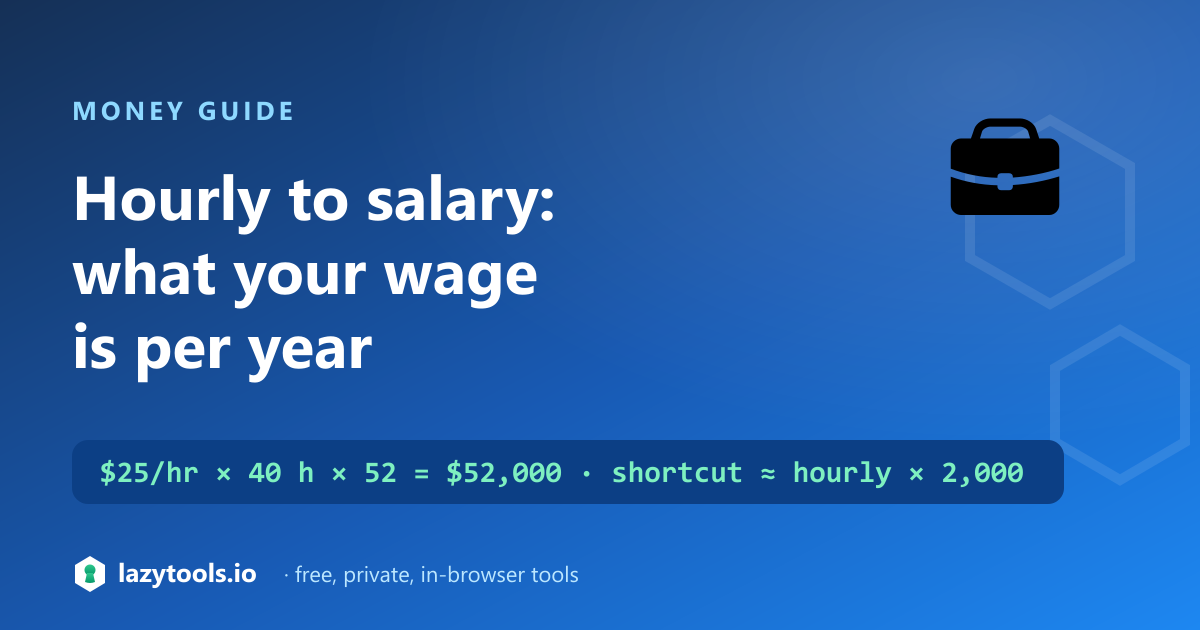
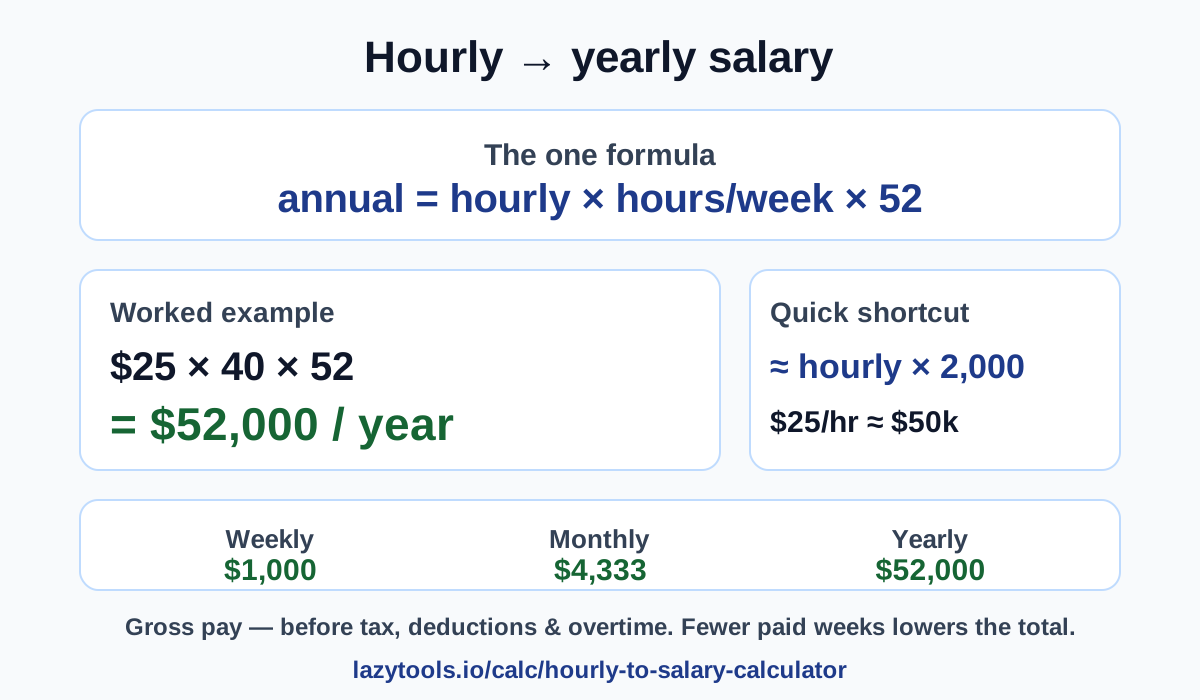
To turn an hourly wage into a yearly salary, multiply your hourly rate by the hours you work per week, then by 52 weeks: annual salary = hourly rate × hours/week × 52. So $25 an hour at 40 hours a week is $25 × 40 × 52 = $52,000 a year, about $1,000 a week and $4,333 a month. This hourly to salary math is the same for any currency; the hourly to salary calculator does it instantly, and everything below shows the logic so you can check it in your head.
The hourly-to-salary formula
Everything comes from one line:
annual salary = hourly rate × hours per week × 52
A standard year has 52 weeks, so if you know how much you earn in one hour and how many hours you work in a week, you multiply out to a year. The two intermediate figures are handy too:
- Weekly pay = hourly rate × hours per week
- Monthly pay = annual salary ÷ 12
Take $25 an hour at 40 hours a week:
- Weekly: $25 × 40 = $1,000
- Annual: $1,000 × 52 = $52,000
- Monthly: $52,000 ÷ 12 ≈ $4,333
Change any input and the whole chain updates. At 30 hours a week instead of 40, the same $25 rate gives $25 × 30 × 52 = $39,000 a year. Part-time hours, a second rate, a raise, it’s always the same multiplication.
Why 52 specifically? A calendar year is 365 days, which is 52 weeks plus one extra day (two in a leap year). Payroll almost always works in whole weeks, so 52 is the standard multiplier and the stray day or two is absorbed into how employers schedule pay periods. If you’re paid every two weeks you’ll see 26 paychecks a year; twice a month, 24. The annual total lands in the same place either way.
One thing the formula quietly assumes: that you’re paid for all 52 weeks. If you take unpaid time off or only work part of the year, use your actual paid weeks instead. Working 50 weeks at $25 × 40 is $50,000, not $52,000. Enter your real hours and weeks to model that.
The ×2,000 mental shortcut
You don’t always have a calculator open. At a 40-hour week there’s a shortcut worth memorizing.
A full 40-hour year is 52 × 40 = 2,080 hours. So:
annual ≈ hourly rate × 2,080
That’s exact for 40 hours a week. But 2,080 is awkward to multiply in your head, so round it to 2,000, which is the same as doubling the rate and adding three zeros:
- $25/hr → about $50,000 (25 × 2,000)
- $50/hr → about $100,000
- $18/hr → about $36,000
The ×2,000 version runs a little low, roughly 4% under the true number, because you dropped the last 80 hours. It’s perfect for a quick gut check (“is this job worth roughly $50k or $75k?”) but reach for ×2,080, or the calculator, when you need the exact figure.
Common hourly rates as annual salary
Here’s what common wages come to at 40 hours a week across all 52 weeks (gross, before tax):
| Hourly rate | Weekly (× 40) | Annual (× 2,080) | ≈ Monthly (÷ 12) |
|---|---|---|---|
| $15 | $600 | $31,200 | $2,600 |
| $18 | $720 | $37,440 | $3,120 |
| $20 | $800 | $41,600 | $3,467 |
| $25 | $1,000 | $52,000 | $4,333 |
| $30 | $1,200 | $62,400 | $5,200 |
| $40 | $1,600 | $83,200 | $6,933 |
| $50 | $2,000 | $104,000 | $8,667 |
Notice how the ×2,000 shortcut lines up: $20 → “$40k” (actual $41,600), $30 → “$60k” (actual $62,400). Always a touch low, always in the right ballpark.
Convert a salary back to an hourly rate
To go the other way. You know the yearly salary and want the hourly equivalent, divide by your paid hours in a year:
hourly rate ≈ annual salary ÷ 2,080
For a $75,000 salary at 40 hours a week:
$75,000 ÷ 2,080 ≈ $36.06 an hour
The mental version divides by 2,000 instead: $75,000 ÷ 2,000 = $37.50, which slightly overstates the rate (the mirror image of the ×2,000 shortcut running low the other direction). This reverse conversion is how you compare a salaried offer against a contract or freelance rate, put both on the same hourly footing first.
One thing to weigh when you do: a salary usually bundles paid time off, while an hourly or contract rate often doesn’t. If a $75,000 salaried role includes three paid weeks off, you’re really earning that $36.06 across 49 worked weeks, so an hourly contractor would need a higher headline rate to match it once their own unpaid holidays are counted. The arithmetic gets you a like-for-like starting point; the paid-time-off difference is the adjustment to make next.
Common mistakes
A few traps turn a clean calculation into a wrong one:
- Confusing gross with take-home. Rate × hours × 52 is gross pay. Income tax, payroll deductions, and benefit contributions all come out before the money reaches you, so your actual take-home is lower. Budget from net, not from the headline annual figure.
- Assuming 52 paid weeks. Unpaid leave, furloughs, or a partial year mean you’re not paid for all 52 weeks. Use your real number of paid weeks or the annual figure will be too high.
- Ignoring overtime. The formula uses one flat rate. If you work paid overtime at a higher rate, those hours earn more than the base calculation shows, add them separately.
- Treating ×2,000 as exact. The 2,000 shortcut is an approximation that runs about 4% low; the precise multiplier for a 40-hour week is 2,080. Know which one you’re using and why.
Check any wage in seconds
The formula is simple, but it’s easy to fumble the arithmetic or forget a factor of 52. The hourly to salary calculator takes your rate, hours, and weeks and shows weekly, monthly, and annual pay at once, and it works the other way, from salary back to hourly. Everything runs 100% in your browser: no wage figures are uploaded or stored anywhere. Browse more money tools like the tip calculator in the calculators hub, or brush up on the math itself in the percentages guide.
Frequently asked questions
How much is $25 an hour annually?
At 40 hours a week, $25/hour is $1,000 a week, $52,000 a year (25 × 40 × 52), and about $4,333 a month ($52,000 ÷ 12). That's gross pay before tax and deductions. Work fewer paid weeks and the yearly figure drops, 50 weeks instead of 52 gives $50,000.
How do you convert hourly to salary?
Multiply your hourly rate by the hours you work per week, then by 52 weeks: annual = rate × hours/week × 52. For example $20 × 40 × 52 = $41,600. Weekly pay is rate × hours; monthly pay is the annual figure divided by 12.
How do I convert a salary back to an hourly rate?
Divide the annual salary by your total paid hours in a year. At 40 hours a week that's 2,080 hours (52 × 40), so hourly ≈ annual ÷ 2,080. A $75,000 salary is about $36.06/hour ($75,000 ÷ 2,080).
Does this include taxes or overtime?
No. Rate × hours × 52 gives gross pay only. It does not subtract income tax, payroll deductions, or benefits, and it does not add overtime. Your take-home pay is lower than the gross annual figure shown.
What is $20 an hour per year?
$20 an hour at 40 hours a week is $41,600 a year (20 × 40 × 52), roughly $3,467 a month and $800 a week, before taxes. The quick mental estimate (×2,000) gives about $40,000, which is close but slightly low.
Why do some estimates use 2,080 hours and others 2,000?
2,080 is exact for a 40-hour week across all 52 weeks (52 × 40). The 2,000 figure is a rounder mental shortcut that's easy to double in your head, $25/hr ≈ $50k. It runs about 4% low, so use 2,080 when you need the precise number.