
explainer
How Much Protein Should You Eat Per Day?
By Uttam Regmi · Published 2026-07-28 · Updated 2026-08-23 · 6 min read · Fact-checked, sources cited
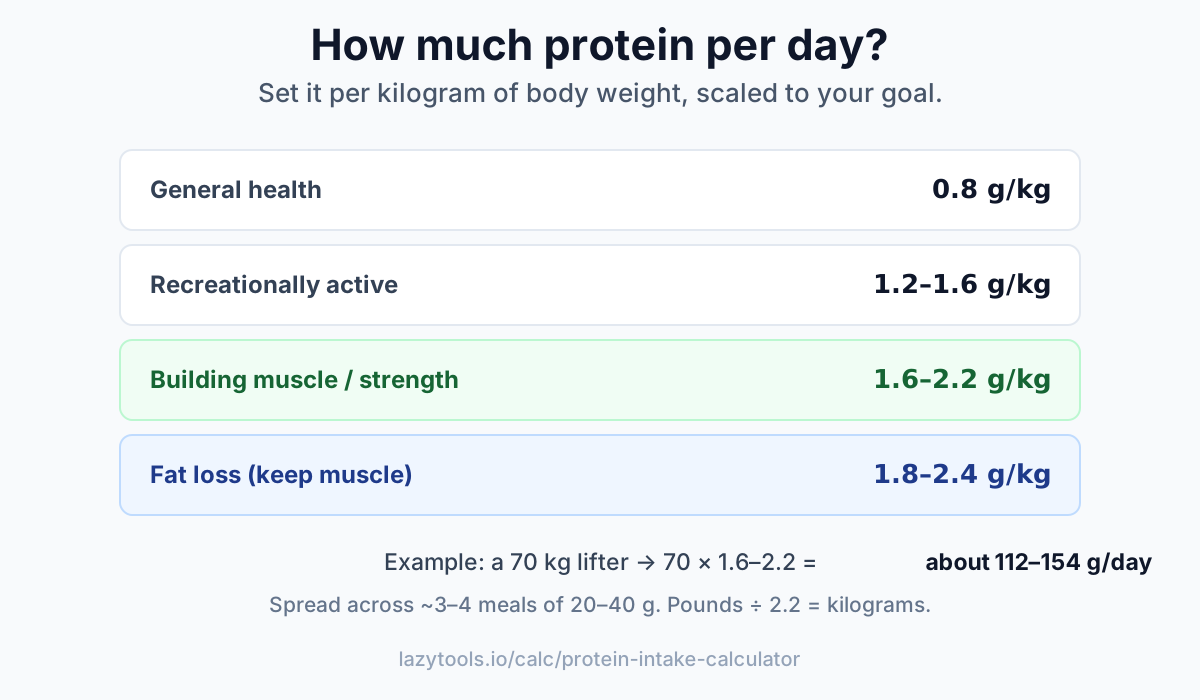
Daily protein is best set per kilogram of body weight and scaled to your goal: roughly 0.8 g/kg for general health, 1.2-1.6 g/kg if you’re active, and 1.6-2.2 g/kg when building muscle or dieting to preserve it. For a 70 kg person aiming to build muscle, that’s about 112-154 grams a day. The right number depends far more on your body weight and training than on a one-size-fits-all figure.
Why protein is set per kilogram
Protein needs scale with body size and how much you train, so sports-nutrition guidance is expressed per kilogram of body weight rather than as a flat number of grams. A 55 kg person and a 95 kg person doing the same training need very different totals. The protein intake calculator multiplies your weight by the right factor for your goal and gives a gram range.
The one figure most people already know, 0.8 g/kg, is the U.S. RDA (Recommended Dietary Allowance). It’s important to understand what that number actually means: it’s the minimum estimated to prevent deficiency in roughly 97-98% of healthy, mostly sedentary adults. It is a floor, not a target for someone who trains, is dieting, or is trying to add muscle. That distinction is the single biggest source of confusion, because “0.8 g/kg is the official recommendation” is true and yet a poor goal for most active people.
A related point: heavier bodies carry more fat mass, which is metabolically far less protein-hungry than muscle. If you carry significant excess weight, basing the calculation on your total body weight can overshoot. In that case, many practitioners scale protein to a goal weight or to lean body mass instead, which usually lands you nearer the middle of the ranges below.
The ranges by goal
These reflect widely-cited guidance from the International Society of Sports Nutrition and the Academy of Nutrition and Dietetics:
| Goal | Protein (g/kg) | Example at 70 kg |
|---|---|---|
| General health (RDA) | ~0.8 | ~56 g |
| Recreationally active | 1.2-1.6 | ~84-112 g |
| Building muscle / strength | 1.6-2.2 | ~112-154 g |
| Fat loss (preserve muscle) | 1.8-2.4 | ~126-168 g |
Building muscle benefits from more protein to support muscle protein synthesis. Dieting actually pushes the range up: in a calorie deficit, higher protein helps you hold onto lean muscle while losing fat, and it’s the most filling macronutrient, which helps with hunger.
A worked example, start to finish
Say you weigh 165 lb and lift three or four times a week with a goal of adding muscle. Here’s the full calculation:
- Convert to kilograms. 165 lb ÷ 2.2 = 75 kg (see kg ↔ lbs if you need the conversion both ways).
- Pick your band. Building muscle is 1.6-2.2 g/kg.
- Multiply. 75 × 1.6 = 120 g at the low end; 75 × 2.2 = 165 g at the high end.
- Choose a working number. Landing in the middle, around 140 g/day, is a sensible, sustainable target. Push toward the top of the range only if progress stalls.
- Divide across meals. 140 g ÷ 4 meals ≈ 35 g per meal, which is comfortably within the effective per-meal window.
If that same person were cutting calories to lose fat, they’d shift up to roughly 1.8-2.4 g/kg (about 135-180 g) to defend their muscle while the scale moves down.
What that looks like on a plate
Grams on a calculator are abstract until you translate them into food. These are approximate, rounded values for common protein sources, enough to plan a day without weighing everything.
| Food | Typical serving | Protein (approx.) |
|---|---|---|
| Chicken breast, cooked | 100 g (3.5 oz) | ~31 g |
| Canned tuna, drained | 100 g | ~25 g |
| Greek yogurt (plain, non-fat) | 170 g cup | ~17 g |
| Cottage cheese | 100 g | ~11 g |
| Large egg | 1 egg | ~6 g |
| Cooked lentils | 1 cup (~200 g) | ~18 g |
| Firm tofu | 100 g | ~15 g |
| Whey protein powder | 1 scoop (~30 g) | ~24 g |
Numbers vary by brand, cut, and preparation, so read labels for anything packaged. Even so, you can see how a chicken-and-lentils dinner plus a yogurt easily clears 60 g in two servings.
How to hit your target
- Anchor meals around a protein source, eggs, dairy, meat, fish, tofu, tempeh, legumes.
- Spread it across the day. Roughly 20-40 g per meal across 3-4 meals supports muscle building better than loading it all into dinner.
- Use easy wins, Greek yogurt, cottage cheese, tinned fish, edamame, or a protein shake to close a gap.
- Track for a week to calibrate; most people underestimate how little protein they eat until they count.
Plant-based? A note on protein quality
Total grams matter most, but protein quality, how complete the amino-acid profile is and how well it’s digested, differs by source. Animal proteins (eggs, dairy, meat, fish) contain all the essential amino acids in ready proportions. Most single plant foods are lower in one or more essential amino acids, with the amino acid leucine being especially important for triggering muscle protein synthesis.
The practical fix is simple: eat a variety of plant proteins across the day, legumes with grains, plus soy foods like tofu, tempeh, and edamame, which are among the more complete plant sources. Vegans and vegetarians aiming to build muscle often do well aiming toward the upper end of their band to account for slightly lower digestibility, rather than treating plant protein as interchangeable gram-for-gram with animal protein.
Common mistakes to avoid
- Treating 0.8 g/kg as a goal. It’s a deficiency floor for sedentary adults, not a training target.
- Counting the whole food’s weight as protein. A 100 g chicken breast is not 100 g of protein, it’s roughly 31 g.
- Backloading everything into dinner. One 90 g hit is less effective for muscle building than three or four moderate servings.
- Chasing ever-higher totals. Past about 2.2 g/kg the extra grams mostly become calories, not muscle.
Is more always better?
Up to a point. Most people see no additional muscle benefit beyond about 2.2 g/kg, and very high intakes mainly add calories. For healthy people, high-protein diets are generally safe, but if you have kidney disease or other medical conditions, protein needs and limits change, talk to a doctor or dietitian.
This is general fitness-nutrition guidance, not medical or personalized dietary advice. Needs vary with age, pregnancy, activity and health conditions.
Frequently asked questions
How much protein should I eat per day?
It depends on your goal and body weight. Roughly 0.8 g per kg of body weight for general health, 1.2-1.6 g/kg if you're active, and 1.6-2.2 g/kg when building muscle. For a 70 kg person building muscle that's about 112-154 grams a day.
How do I convert my weight from pounds to kilograms?
Divide your weight in pounds by 2.2. For example, a 154 lb person weighs 70 kg. Then multiply your kg weight by the g/kg factor for your goal to get your daily protein target.
Is 0.8 g/kg enough protein?
That figure is the U.S. RDA, the minimum estimated to prevent deficiency in most sedentary adults. It is a floor, not a target for people who train, are dieting, or are trying to build muscle, who generally need more.
Do I need more protein when losing weight?
Yes. In a calorie deficit, higher protein (around 1.8-2.4 g/kg) helps preserve lean muscle while you lose fat, and protein is the most filling macronutrient, which helps manage hunger.
Should I spread protein across the day?
Spreading roughly 20-40 g across 3-4 meals supports muscle building more effectively than one large serving. Eating past about 2.2 g/kg total offers little added benefit for most people.
Should I base protein on total body weight or goal weight?
If you carry significant excess weight, basing the calculation on total body weight can overshoot, since fat mass needs far less protein than muscle. Many practitioners scale to a goal weight or lean body mass instead.