
how-to
Kids' Shoe Sizes by Age: US, UK, EU Charts, and the 13C-to-1Y Mystery
By Uttam Regmi · Published 2026-07-05 · Updated 2026-08-23 · 6 min read · Fact-checked, sources cited

US children’s shoe sizes run 2C through 13.5C, and then restart at 1Y, where 1Y is bigger than 13.5C. That restart confuses more parents than anything else in kids’ sizing. The full logic, the age charts, and the measuring method below; for any specific size, the kids’ shoe size converter maps US, UK, EU and centimeters instantly.
The chart: sizes, centimeters and typical ages
| US | UK | EU | Foot (cm) | Typical age |
|---|---|---|---|---|
| 4C | 3 | 19.5 | 11.4 | 9-18 mo |
| 6C | 5 | 22 | 13.0 | 1.5-2.5 yr |
| 8C | 7 | 25 | 14.6 | 2.5-3.5 yr |
| 10C | 9 | 27 | 16.5 | 3.5-4.5 yr |
| 12C | 11 | 30 | 18.1 | 5-6 yr |
| 13C | 12 | 31 | 19.0 | 6-7 yr |
| 1Y | 13 | 32 | 19.7 | 7-8 yr |
| 3Y | 2 | 35 | 21.6 | 9-10 yr |
| 5Y | 4 | 37.5 | 23.3 | 11-12 yr |
| 7Y | 6 | 40 | 25.0 | 13+ yr |
The converter carries every half-step and the age groups (baby/toddler → little kid → big kid).
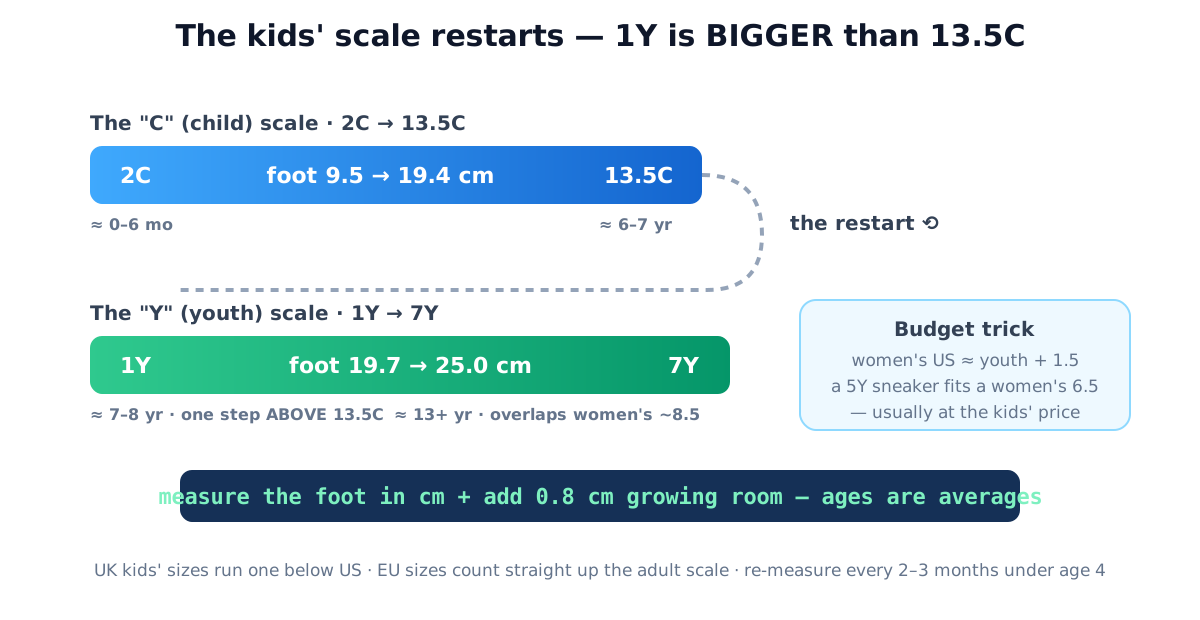
Why the restart exists
The C and Y scales are one continuous barleycorn ladder wearing two labels, a leftover from English sizing history, where children’s sizes counted up from a tiny zero and simply rolled over at 13. Nobody designed it; everyone inherited it. EU sizing has no restart (a big kid just wears EU 33 after 32), and UK kids’ sizes shadow the US scale one step lower, rolling over the same way.
The barleycorn is the old English unit behind all of this: one shoe size equals one-third of an inch (≈8.5 mm), and a half size is one-sixth of an inch (≈4.2 mm). That is why the whole ladder feels so granular, each step forward is only a few millimetres of foot length, which is exactly why measuring in centimetres beats guessing. The EU scale uses a different unit, the Paris point of two-thirds of a centimetre (≈6.7 mm per size), and counts continuously from tiny toddler numbers up into adult sizes with no rollover at all, arguably the cleaner system, and the reason a single EU number (say 32) is often the least ambiguous way to specify a child’s size across brands.
A worked conversion
Suppose you measure a child’s longest foot at 19.0 cm. Add the standard ~0.8 cm of growing room and you are fitting for about 19.8 cm of internal length. On the chart that lands right at the restart: it is 1Y in US sizing, not 13C, even though “13” is the bigger-looking number. In other systems the same foot is roughly UK 13 and EU 32. Feed the raw 19.0 cm into the kids’ shoe size converter and it applies the growing-room rule and the rollover for you, so you never have to remember which side of the 13C-to-1Y seam you are on.
📌 Citable fact US children's shoe sizes run 0C-13.5C ("child") and then restart at 1Y-7Y ("youth"); 1Y (≈19.7 cm foot) is one step larger than 13.5C. Women's US sizes correspond to youth sizes plus ≈1.5, a 5Y equals about a women's 6.5.
Measuring a child’s foot (the only reliable method)
- Afternoon, standing, in socks, feet swell during the day and lengthen under body weight.
- Heel against a wall on a sheet of paper; mark the longest toe (often the second toe).
- Measure wall-to-mark in cm. Do both feet; fit the larger.
- Add ~0.8 cm growing room, a thumb’s width. Enter the raw measurement in the converter; it applies the chart.
For wriggly toddlers: trace the foot on paper and measure the tracing. Check fit monthly by feeling for the big toe with the child standing, when it reaches within ~3 mm of the front, it’s time.
Why buying by age fails
Ages on size charts are population medians, and children’s feet spread widely around them: at age 4 the normal range spans roughly three full sizes. Growth is also uneven, spurts of half a size in two months, then quiet stretches. The cm measurement plus growing room sidesteps all of it, and prevents both the “outgrown in three weeks” purchase and the flopping oversized one that ruins gait.
Signs the current pair is outgrown
Children rarely say a shoe is too small. They adapt, then start tripping or refusing to walk. Check for these instead:
- Red marks or indentations across the top of the foot or around the heel after the shoe comes off.
- The big toe pressing the front, with the child standing, feel for the toe; less than ~3 mm of room means it’s time.
- Curled or clawed toes, or the child folding them under inside the shoe.
- Heel slippage the wrong way, a shoe that was snug now slides because the foot has shifted forward to find room.
- Rapid, patternless wear on one edge of the sole, a sign the gait has changed to compensate.
Because feet can gain half a size in a single season before age four, a pair that fit perfectly at purchase can be tight in eight to ten weeks, which is why the re-measure interval matters more than the size on the box.
The youth-to-women’s trick
Because youth sizes reach 7Y (≈ women’s 8.5), anyone wearing women’s ≤ 8.5 can often buy the same sneaker model in big-kid sizing at a substantially lower price: women’s size − 1.5 = youth size (a women’s 7.5 → 6Y). The relationship works because the youth and men’s scales share the same length at the top of the range, and women’s US sizes run about 1.5 steps above men’s. It is an approximation, not a guarantee, brands vary by up to half a size, so treat the table below as a starting point and check the cm length whenever the maker publishes it.
| Youth (US) | ≈ Women’s US | ≈ Foot (cm) |
|---|---|---|
| 4Y | 5.5 | 22.5 |
| 5Y | 6.5 | 23.3 |
| 6Y | 7.5 | 24.1 |
| 7Y | 8.5 | 25.0 |
Width is the real caveat: youth lasts are generally cut narrower than women’s, so a foot that is at all wide may fit the length but pinch across the ball. If a shoe comes in width options, that alone can decide whether the kids’-price version actually works for an adult foot.
Common mistakes
- Reading 1Y as smaller than 13C, it’s the next size up.
- Buying by age, measure; the age column is a sanity check, not a fitting method.
- Fitting the smaller foot, always the larger.
- “Room to grow” oversizing, more than ~1.5 cm extra causes tripping.
- Hand-me-downs judged by label, worn shoes mold to the first wearer; check length and wear.
Quick summary
Kids’ US sizes climb 2C-13.5C and then restart at 1Y, which is one step bigger, the restart, not the sizes, is what confuses everyone. Skip age-based buying entirely: measure the foot in centimeters, add 0.8 cm of growing room, and let the kids’ shoe size converter find the size in every system.
Related: the adult shoe size converter · clothing sizes · cm to inches.
Frequently asked questions
Why do kids' sizes go from 13C to 1Y?
The child (C) scale ends at 13.5C and the youth (Y) scale restarts at 1, an artifact of the old barleycorn sizing system. 1Y is one step LARGER than 13.5C, not a step down. Youth sizes run to 7Y.
What shoe size is a 2-year-old?
Typically US 6C-8C (EU 22-25, foot 13-14.6 cm), but healthy feet vary enormously, measure in cm rather than buying by age.
How much growing room do kids' shoes need?
About 0.8 cm, a thumb's width, beyond the longest toe. Less gets outgrown in weeks; much more than 1.5 cm causes tripping and poor gait.
How often should I measure my child's feet?
Every 2-3 months under age 4 (feet can grow half a size a season), every 4-6 months after. Always measure both feet and fit the larger.
Do youth sizes convert to women's sizes?
Yes: women's US ≈ youth + 1.5. A 5Y equals about a women's 6.5, the well-known trick for buying smaller women's sizes at kids' prices.
How do EU kids' sizes work?
EU sizes just continue the adult Paris-point scale downward (a toddler EU 22, a big kid EU 35) with no restart, arguably the saner system. The converter maps them to US C/Y and UK.