
explainer
How to Measure Body Fat with a Tape (The US Navy Method)
By Uttam Regmi · Published 2026-07-28 · Updated 2026-07-28 · 6 min read · Fact-checked, sources cited
The US Navy method estimates your body-fat percentage from a tape measure: men measure their neck and waist, women measure neck, waist and hips, and both use their height. Those circumferences are put into a formula that returns a body-fat percentage, no scales, calipers or lab needed. It’s an estimate, typically within about 3% of more precise methods for average builds, and it’s the same approach the US military uses for routine screening.
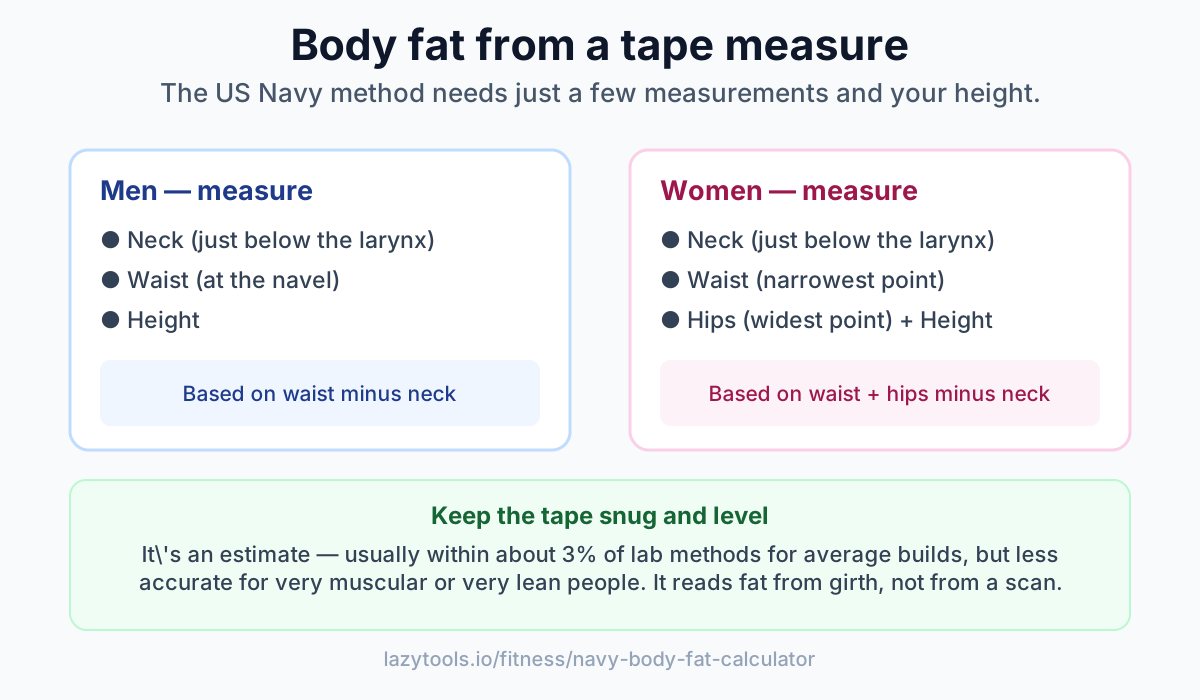
What you measure
The method (developed by researchers Hodgdon and Beckett at the Naval Health Research Center in the 1980s) works because body fat tends to accumulate around the midsection. That makes waist circumference, read against the leaner reference points of the neck and your height, a surprisingly good proxy for overall body-fat percentage.
- Men: neck, waist, and height. The result is driven by waist minus neck.
- Women: neck, waist, hips, and height. The result is driven by waist plus hips minus neck.
Enter those into the Navy body-fat calculator (in cm or inches) and it returns your estimated body-fat percentage and category.
Here is the full list of what each person needs, so nothing is missed on measurement day:
| Measurement | Men | Women | Where to place the tape |
|---|---|---|---|
| Height | Yes | Yes | Standing straight, no shoes |
| Neck | Yes | Yes | Just below the larynx |
| Waist | Yes | Yes | Navel (men) / narrowest point (women) |
| Hips | No | Yes | Widest point of the buttocks |
The reason women add a third circumference is that the female fat distribution pattern (more storage around the hips and thighs) is not captured by a waist-and-neck reading alone, so the equation needs the hip measurement to stay accurate.
How to measure correctly
Measurement technique is where most of the error creeps in, so take your time and use a flexible tape:
- Neck: just below the larynx (Adam’s apple), with the tape sloping slightly downward to the front. Don’t flare your neck.
- Waist (men): horizontally at the level of the navel.
- Waist (women): at the narrowest point of the torso.
- Hips (women): at the widest point of the buttocks.
- Keep the tape snug but not compressing the skin, and level all the way around.
- Measure on bare skin, relaxed (don’t suck in), and take each measurement two or three times, using the average.
What the numbers mean
Body-fat percentage is often grouped into these bands (American Council on Exercise):
| Category | Men | Women |
|---|---|---|
| Essential fat | 2-5% | 10-13% |
| Athletes | 6-13% | 14-20% |
| Fitness | 14-17% | 21-24% |
| Average | 18-24% | 25-31% |
| Above average | 25%+ | 32%+ |
Women carry more essential fat than men for normal physiological function, which is why the healthy ranges differ.
A worked example
Suppose a man is 178 cm tall (about 5 ft 10 in), with a neck of 38 cm and a waist of 90 cm at the navel. The engine of the calculation is the gap between his waist and neck. Here 90 − 38 = 52 cm, read against his height. A larger waist-minus-neck gap, for a given height, pushes the estimate up; a leaner waist pulls it down. Plugging those numbers into the Navy body-fat calculator returns roughly 20%, which sits in the “average” band in the table above.
Now change one thing: trim the waist to 84 cm while everything else stays the same. The gap drops to 46 cm and the estimate falls by about four points into the mid-teens, the “fitness” band. That sensitivity is exactly why the waist reading deserves the most care: a centimetre or two of sloppy tape placement moves the result more than any other input.
For a woman, the same logic applies but with hips added: the driver is waist + hips − neck. A woman who is 165 cm tall with a 32 cm neck, 74 cm waist and 98 cm hips has a driver of 74 + 98 − 32 = 140 cm, which the formula reads against her height to return roughly 28%, the “average” band for women. Shrinking the waist while hips and neck hold steady lowers the estimate.
How accurate is it?
For people of average build, the Navy method usually lands within about 3 percentage points of gold-standard methods like DEXA or hydrostatic weighing, good enough to track progress over weeks and months. Its weakness is that it infers fat from body measurements alone, so it can overestimate for very muscular people (a thick waist that’s muscle, not fat) and misjudge very lean or unusual body shapes. Consistency matters more than a single reading: measure the same way each time and watch the trend.
Because it relies on your waist measurement, it also doubles as a rough health signal, a rising waist circumference is itself linked to metabolic risk, independent of the exact body-fat figure, and it pairs well with a BMI reading for a fuller picture.
How it compares to other methods
No at-home method matches a laboratory scan, but they differ a lot in cost, convenience and what throws them off. The tape method’s appeal is that it is free, repeatable and immune to the hydration swings that plague electrical methods.
| Method | Cost | Convenience | Main weakness |
|---|---|---|---|
| Navy tape method | Free | Do it anywhere | Sensitive to tape placement; assumes typical fat distribution |
| Bioelectrical impedance (smart scale) | Low | Very quick | Swings with hydration, food and time of day |
| Skinfold calipers | Low | Needs practice | Technique-dependent; hard to self-measure the back |
| DEXA scan | High | Clinic visit | Cost and access; small dose of radiation |
| Hydrostatic weighing | High | Specialist facility | Requires full submersion; limited availability |
The practical takeaway: pick one method and stick with it. Comparing a caliper reading one month to a smart-scale reading the next tells you almost nothing, because the errors point in different directions. Measured the same way each time, the tape method is one of the most repeatable options on this list, which is precisely what you want when the goal is tracking a trend rather than pinning down a single true number.
When to be cautious with the result
Treat the estimate as a ballpark, not a verdict, if you are very muscular, very lean, pregnant, or have a body shape that differs from the population the formula was built on. Bodybuilders in particular tend to see inflated readings because a large, muscular waist looks like fat to a tape that cannot tell the two apart. In those cases the trend over time is still useful even when the absolute number is off.
Frequently asked questions
What measurements does the US Navy body-fat method need?
Men measure their neck, waist and height; women measure their neck, waist, hips and height. Those circumferences are entered into the Navy formula, which returns an estimated body-fat percentage with no scales or calipers required.
How accurate is the Navy body-fat method?
For people of average build it usually lands within about 3 percentage points of gold-standard methods like DEXA or hydrostatic weighing. It is less accurate for very muscular or very lean people because it infers fat from body measurements rather than measuring it directly.
Where exactly do I place the tape to measure my waist?
For men, measure horizontally at the level of the navel. For women, measure at the narrowest point of the torso. Keep the tape snug and level, stand relaxed, and do not suck in your stomach or hold your breath.
Why are the healthy body-fat ranges different for men and women?
Women's bodies require more essential fat for normal hormonal and reproductive function, so a healthy body-fat percentage is naturally higher for women than for men. This is why the category bands differ between the two.
Can I measure in inches instead of centimetres?
Yes. The Navy body-fat calculator accepts either centimetres or inches and converts internally. Just be consistent and use the same unit for all of your measurements.