
explainer
How Many Gallons Is My Pool? (Volume by Shape)
By Uttam Regmi · Published 2026-07-28 · Updated 2026-08-23 · 6 min read · Fact-checked, sources cited
Your pool’s volume is its surface area times its average depth: length × width × average depth for a rectangular pool, or π × radius² × average depth for a round one, then convert to gallons. An 8 × 4 metre pool averaging 1.5 m deep holds 48 m³, which is about 12,680 US gallons. Knowing that number accurately is the foundation for dosing chlorine, shock and every other pool chemical correctly.
The formulas by shape
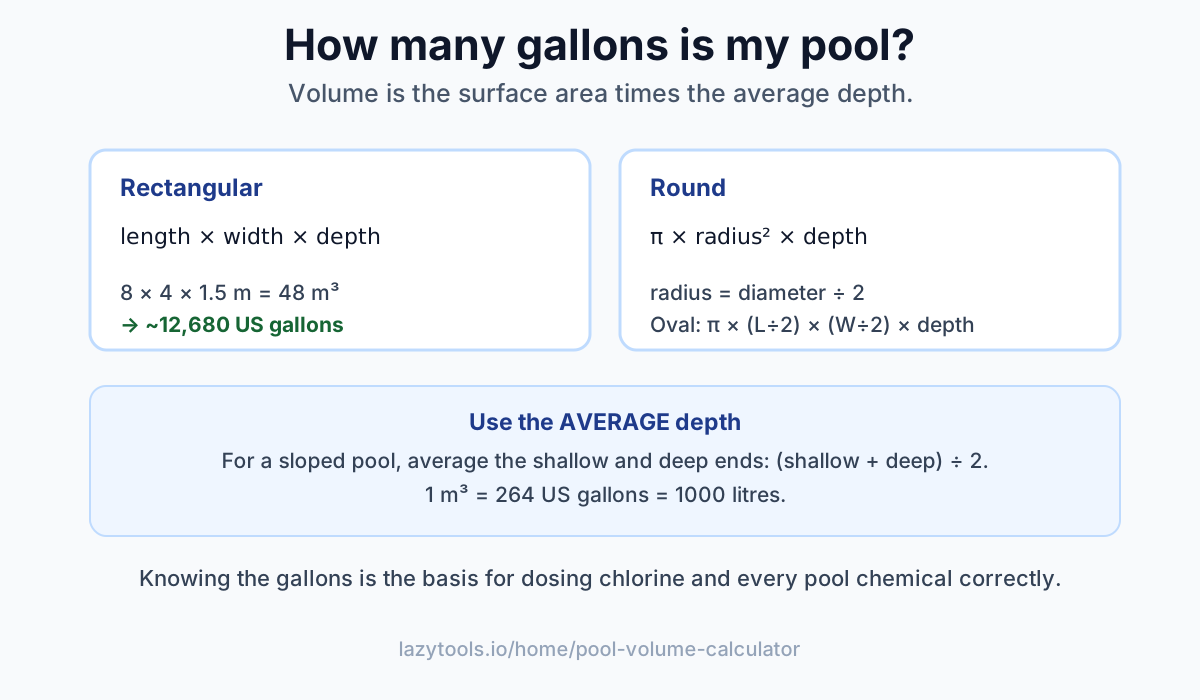
Pool volume is always area × average depth; only the area formula changes with shape:
- Rectangular / square: length × width × average depth
- Round: π × radius² × average depth (radius = diameter ÷ 2)
- Oval: π × (length ÷ 2) × (width ÷ 2) × average depth
Work in consistent units (all metres, or all feet), then convert the result to gallons. The pool volume calculator does the geometry and the conversion for you in US gallons, litres and cubic metres. (The surface-area step is the same math covered in how to calculate square footage if you want a refresher.)
A quick way to remember the imperial version: if you measure everything in feet, multiply length × width × average depth to get cubic feet, then multiply by 7.48 to get US gallons. Many pool guides round that factor to 7.5 for mental arithmetic, which is close enough for dosing.
Worked examples
Numbers make the formulas concrete. Here are three pools, one per shape, worked end to end.
Rectangular (imperial). A backyard pool measuring 32 ft long × 16 ft wide, 3 ft at the shallow end and 7 ft at the deep end. Average depth = (3 + 7) ÷ 2 = 5 ft. Volume = 32 × 16 × 5 = 2,560 ft³. In gallons: 2,560 × 7.48 ≈ 19,150 US gallons.
Round (imperial). A 24 ft diameter above-ground pool with a uniform 4 ft water depth. Radius = 12 ft, so area = π × 12² ≈ 452.4 ft². Volume = 452.4 × 4 ≈ 1,810 ft³, which is 1,810 × 7.48 ≈ 13,540 US gallons.
Oval (metric). An oval pool 6 m long × 3.5 m wide, averaging 1.4 m deep. Volume = π × (6 ÷ 2) × (3.5 ÷ 2) × 1.4 = π × 3 × 1.75 × 1.4 ≈ 23.1 m³. In gallons: 23.1 × 264.2 ≈ 6,100 US gallons (about 23,100 litres).
The average-depth trick
Most pools aren’t a uniform depth. They slope from a shallow to a deep end. Using the deep-end depth overstates the volume; using the shallow end understates it. Instead, use the average:
average depth = (shallow-end depth + deep-end depth) ÷ 2
A pool that’s 1 m at the shallow end and 2 m at the deep end has an average depth of 1.5 m. For pools with a more complex bottom (a spoon or hopper shape), the simple average is a good approximation.
The catch is that many pools don’t slope evenly from end to end. A common design is a long flat shallow section, then a short slope down to a deep well. If two-thirds of the floor sits at the shallow depth, a plain shallow-plus-deep average overstates the water. When accuracy matters, split the pool into sections, shallow flat, sloped, and deep flat, calculate each one’s volume separately, and add them. For chlorine and shock, though, the simple average is usually close enough; pool chemistry tolerates being within a few percent.
Unit conversions
Once you have the volume, convert to the unit your chemicals are dosed in:
| From | To US gallons | To litres |
|---|---|---|
| 1 cubic metre (m³) | 264.2 | 1000 |
| 1 cubic foot (ft³) | 7.48 | 28.3 |
So the 48 m³ example is 48 × 264.2 ≈ 12,680 US gallons (or 48,000 litres).
One more distinction worth knowing: a US gallon and an imperial (UK) gallon are not the same. One imperial gallon is about 1.2 US gallons (4.546 litres versus 3.785). Pool-chemical labels sold in North America assume US gallons, so unless a product specifically says imperial, treat “gallons” as US gallons.
Typical pool sizes for reference
If you can’t measure yet, these ballpark figures show the range you’re likely in. Always calculate from your own dimensions before dosing. This table is only a sanity check.
| Pool | Dimensions (approx.) | Average depth | Volume |
|---|---|---|---|
| Round above-ground | 15 ft diameter | 4 ft | ~5,300 US gal |
| Round above-ground | 24 ft diameter | 4 ft | ~13,500 US gal |
| Small rectangular in-ground | 24 × 12 ft | 5 ft | ~10,800 US gal |
| Medium rectangular in-ground | 32 × 16 ft | 5 ft | ~19,150 US gal |
| Large rectangular in-ground | 40 × 20 ft | 5.5 ft | ~32,900 US gal |
Why you need the number
Pool chemistry is entirely dose-per-volume. Chlorine, shock, algaecide, pH increaser/decreaser, stabiliser and clarifier are all specified as an amount per so many gallons or litres. Get the volume wrong and you’ll either under-dose (cloudy, unsafe water) or over-dose (wasted product, irritated eyes and skin, damaged surfaces). An accurate gallon figure, measured once, makes every future chemical calculation right.
Volume drives more than chemicals. Your filter and pump are sized to “turn over” the whole pool in a target window, often around one full circulation every 8 hours, so the right pump flow depends directly on total gallons. Heater run-time and the cost of heating scale with volume too. Because the number gets used again and again, it pays to measure carefully once and write it on the equipment-pad wall or save it in the calculator.
Common mistakes to avoid
- Using the deep-end depth for the whole pool. This is the single most common error and can overstate volume by 30% or more. Always average.
- Mixing units. Feet with metres, or inches with feet, silently ruins the result. Convert everything first.
- Confusing US and imperial gallons. A 20,000-gallon figure means very different dose amounts depending on which gallon you mean.
- Guessing from a “typical size” chart. Two 32-foot pools can differ by thousands of gallons depending on depth and shape. Measure your own.
Frequently asked questions
How do I calculate how many gallons my pool holds?
Multiply the surface area by the average depth to get the volume, then convert. For a rectangular pool that is length x width x average depth; for a round pool it is pi x radius squared x average depth. Convert cubic feet to US gallons by multiplying by 7.48, or cubic metres by 264.2.
How many gallons is a typical 8 x 4 metre pool?
An 8 x 4 metre pool averaging 1.5 m deep holds 48 cubic metres, which is about 12,680 US gallons (roughly 48,000 litres).
What average depth should I use for a sloped pool?
Use the average of the shallow-end and deep-end depths: (shallow depth + deep depth) divided by 2. A pool that is 1 m at the shallow end and 2 m at the deep end has an average depth of 1.5 m.
How do I convert cubic feet to gallons?
Multiply cubic feet by 7.48 to get US gallons. Many pool guides round this to 7.5 for quick mental arithmetic, which is close enough for chemical dosing.
Why do I need to know my pool's volume?
The volume in gallons is the basis for every pool chemical dose, including chlorine and shock. Getting the volume right is what keeps your chlorine, pH and shock treatments accurate.
How do I calculate the volume of a round pool?
Use pi x radius squared x average depth, where the radius is the diameter divided by 2. For example, a 24 ft diameter pool with a uniform 4 ft depth has a radius of 12 ft, an area of about 452.4 square feet, and a volume of about 1,810 cubic feet, or roughly 13,540 US gallons.