
explainer
How Much Does It Cost to Run an Appliance? (Watts to Dollars)
By Uttam Regmi · Published 2026-07-28 · Updated 2026-08-23 · 7 min read · Fact-checked, sources cited
To work out what an appliance costs to run, multiply its power in kilowatts (watts ÷ 1000) by the hours you use it and by your electricity price per kilowatt-hour. A 1500-watt space heater used 5 hours a day at $0.20/kWh costs 1.5 × 5 × 0.20 = $1.50 a day, which is about $45 a month or $547 a year. The wattage is on the appliance’s label; the price per kWh is on your electricity bill.
The formula
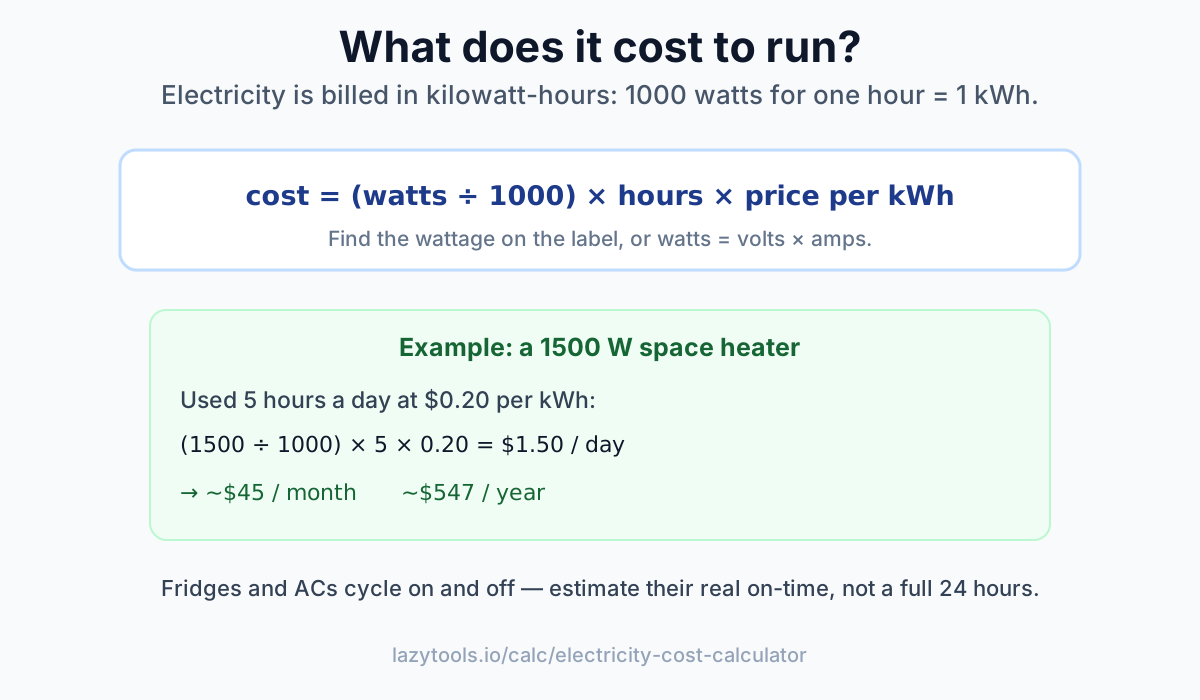
Your electricity company charges by the kilowatt-hour (kWh), the energy of 1000 watts running for one hour. So the cost to run anything is:
cost = (watts ÷ 1000) × hours of use × price per kWh
The first part (watts ÷ 1000 × hours) is the energy in kWh; multiplying by your rate turns it into money. The electricity cost calculator does it and projects the daily figure to a month and a year.
Two numbers do all the work, and both are easy to find. The wattage comes from the appliance itself; the price per kWh comes from your latest bill (in many places a typical residential rate falls somewhere in the range of roughly $0.10–$0.35 per kWh, the US Energy Information Administration publishes average rates, but yours may sit outside that, so always use your own figure). Everything else is just multiplication.
Why the ÷ 1000 step matters
Watts and kilowatts trip people up more than anything else in this calculation. A watt is a unit of power, the rate at which energy is used right now. A kilowatt is simply 1000 watts. Because bills are priced per kilowatt-hour, you have to divide watts by 1000 before multiplying by hours, or your answer will be 1000× too big. A 60 W bulb left on for one hour uses 0.06 kWh, not 60.
Finding the wattage
- Look on the rating label (usually on the back or base) or in the manual, it’s given in watts (W).
- If only volts and amps are listed: watts = volts × amps. A device drawing 2 A at 120 V uses 240 W.
- Nameplate wattage is the maximum; some devices draw less in normal use.
- For the most honest figure, use a plug-in energy monitor. It sits between the socket and the plug and reads the real watts drawn moment to moment, and most models total the kWh over days or weeks so you can price a whole cycle rather than guessing.
Worked examples
| Appliance | Power | Use | At $0.20/kWh |
|---|---|---|---|
| LED bulb | 10 W | 5 h/day | ~$0.01/day |
| Desktop PC | 200 W | 6 h/day | ~$0.24/day |
| Space heater | 1500 W | 5 h/day | ~$1.50/day |
| Tumble dryer | 3000 W | 1 h/load | ~$0.60/load |
| Fridge (label) | 150 W avg | 24 h/day* | ~$0.72/day* |
*A fridge’s compressor cycles, so use its average power or the annual kWh figure on its energy label rather than assuming it runs flat-out all day.
Work through the space heater line to see the pattern. Its 1500 W is 1.5 kW. Run for 5 hours that is 1.5 × 5 = 7.5 kWh a day. At $0.20/kWh that is 7.5 × 0.20 = $1.50 a day. Multiply by 30 for a month ($45) and by 365 for a year ($547). The same three steps price anything on the list, only the numbers change.
From daily to monthly and yearly
A cost “per day” rarely lands until you scale it up. Once you have a daily figure, multiply by roughly 30 for a month and 365 for a year (or price a single cycle, a load of laundry, one dishwasher run, and multiply by how often you run it). Small daily numbers add up fast over a year, which is exactly why a cheap-sounding device can still matter:
| Daily cost | Per month (×30) | Per year (×365) |
|---|---|---|
| $0.10 | ~$3 | ~$37 |
| $0.50 | ~$15 | ~$183 |
| $1.00 | ~$30 | ~$365 |
| $1.50 | ~$45 | ~$548 |
How appliances stack up
Not every device is worth worrying about. As a rough guide, wattages cluster into bands, and it is the top band, anything with a heating element or a motor that runs for hours, that dominates a bill:
| Band | Typical devices | Rough wattage |
|---|---|---|
| Very low | Phone charger, LED bulb, router | ~5-20 W |
| Low | Laptop, TV, games console | ~50-200 W |
| Moderate | Desktop PC, fridge (average), microwave | ~150-1200 W |
| High | Space heater, hairdryer, kettle, AC | ~1000-3000 W |
| Very high | Tumble dryer, electric oven, water heater | ~2000-5000 W+ |
The takeaway: a 10 W gadget left on all year costs pennies, while a 2000 W heater run daily is one of the largest single lines on your bill. Time on and wattage both matter, a low-wattage device running 24/7 can still out-cost a high-wattage one used for minutes.
Why fridges and ACs cost less than expected
Heaters, kettles and lights draw a steady load, so the simple formula is accurate. But fridges, freezers and air conditioners cycle, the compressor switches on to cool, then off, repeatedly. If you plug in the nameplate wattage and assume 24 hours, you’ll overestimate. Instead:
- Use the appliance’s annual kWh figure (on the EU energy label or US EnergyGuide), or
- Estimate the fraction of the day the compressor actually runs (often 30-50%).
For example, a fridge with a 150 W compressor that actually runs about 40% of the time averages roughly 60 W over the day, around 1.4 kWh, not the 3.6 kWh you’d get from assuming it runs flat out. The annual-kWh label already bakes this cycling in, which is why it is the most reliable number for anything that switches itself on and off.
Don’t forget standby power
Many devices keep drawing a trickle even when “off”, TVs, consoles, set-top boxes, and anything with a standby light or an always-on network chip. Each is small, often a watt or a few watts, but they run 24 hours a day, every day, and there can be a dozen of them in a home. Individually trivial, collectively they add a modest but permanent baseline to your bill. A switchable power strip for the entertainment cluster is the simplest fix.
Cutting the cost
Once you can see the numbers, the big savers become obvious: it’s the high-wattage, long-running devices that dominate a bill, heating, cooling, water heating, tumble dryers, not phone chargers or standby lights. A few high-leverage moves:
- Attack the top band first. Trimming an hour a day off a 2000 W heater saves more than unplugging every charger in the house.
- Heat and cool smaller zones. Warming or cooling one occupied room instead of the whole home cuts run-time directly.
- Shift to off-peak rates if your tariff has them, running the dishwasher or dryer when the per-kWh price is lower changes the bill without changing the energy used.
- Replace the biggest hogs with efficient models; the payback on an old fridge or an inefficient dryer can be surprisingly fast. If you are weighing rooftop generation against these running costs, see how many solar panels you need.
- Line-dry when you can, a tumble dryer is one of the most expensive things to run per hour in most homes.
Run each candidate through the electricity cost calculator before and after a change and you’ll see, in your own currency, exactly which habits are worth keeping.
Frequently asked questions
What is the formula for an appliance's running cost?
Cost = (watts divided by 1000) times hours of use times your price per kWh. The first part gives the energy in kilowatt-hours, and multiplying by your rate turns it into money.
How much does a 1500-watt space heater cost to run?
Used 5 hours a day at $0.20/kWh it costs 1.5 x 5 x 0.20 = $1.50 a day, which works out to roughly $45 a month or about $547 a year. Change the hours and your own rate to match your situation.
Where do I find an appliance's wattage?
Look on the rating label, usually on the back or base, or in the manual, where it is given in watts. If only volts and amps are listed, multiply them: watts = volts x amps.
Why do I divide watts by 1000?
Bills are priced per kilowatt-hour, and a kilowatt is 1000 watts. Dividing watts by 1000 converts to kilowatts before multiplying by hours, otherwise your answer would be 1000 times too big.
Why do fridges and air conditioners cost less than the maths suggests?
They cycle on and off rather than running continuously, so their nameplate wattage is not drawn for a full 24 hours. Use their average on-time or the annual kWh figure on the energy label instead of assuming constant use.
Does this calculation work in any currency?
Yes. The maths is currency-agnostic; just enter your electricity rate in whatever units your bill uses and the result comes out in that same currency.