
explainer
What Grade Do I Need on My Final? (The Formula)
By Uttam Regmi · Published 2026-07-28 · Updated 2026-07-28 · 6 min read · Fact-checked, sources cited

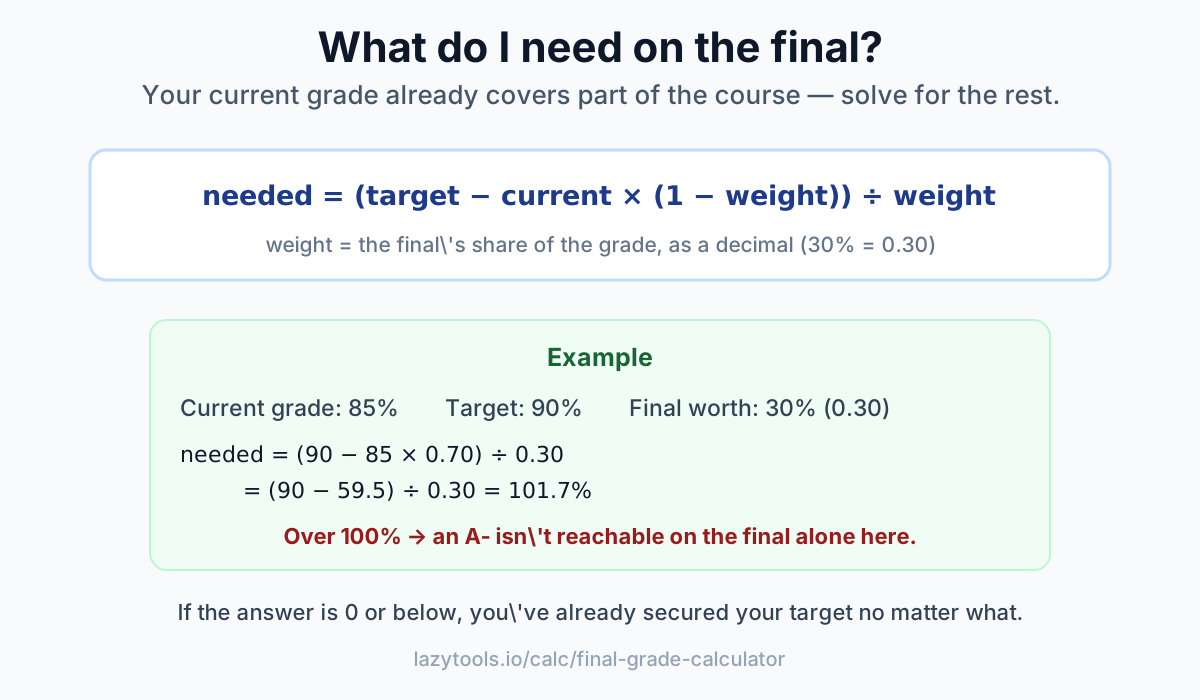
To work out the score you need on your final exam, use: needed = (target − current grade × (1 − final’s weight)) ÷ final’s weight. For example, with an 85% current grade, a 90% target, and a final worth 30% of the course, you need (90 − 85 × 0.70) ÷ 0.30 = 101.7%, just out of reach, which tells you a 90% isn’t attainable from the final alone. The formula also reveals when your target is already locked in no matter how the final goes.
The idea behind the formula
Your course grade is a weighted average. If the final is worth w of your grade (say 30%, i.e. w = 0.30), then everything else you’ve done so far, quizzes, homework, midterms, covers the other (1 − w) (70%). Your current grade is the average of that already-completed part.
So your final course grade will be:
course grade = current × (1 − w) + final × w
Set that equal to your target and solve for the final score:
needed = (target − current × (1 − w)) ÷ w
That’s the exact score you’d need on the final to land precisely on your target. The final grade calculator does it instantly and tells you whether it’s achievable.
The single most useful thing this rearrangement shows you is leverage. The weight w sits in the denominator, so a heavier final gives each point you earn more pull on the course grade, but it also makes the gap between your current grade and your target harder to close in either direction. A light final (say 10%) barely moves your grade no matter how you do; a heavy one (say 50%) can rescue or sink a semester. Knowing w before you plan your studying tells you how much the final is actually worth fighting for.
Worked examples
Reachable target. Current 88%, target 85%, final worth 40% (w = 0.40): needed = (85 − 88 × 0.60) ÷ 0.40 = (85 − 52.8) ÷ 0.40 = 80.5%. Very doable.
Out of reach. Current 85%, target 90%, final worth 30%: needed = (90 − 85 × 0.70) ÷ 0.30 = (90 − 59.5) ÷ 0.30 = 101.7%. Above 100%, so a 90% overall isn’t possible from the final alone, you’d need extra credit or a lower target.
Already locked in. Current 95%, target 80%, final worth 25%: needed = (80 − 95 × 0.75) ÷ 0.25 = (80 − 71.25) ÷ 0.25 = 35%. You only need 35% on the final to keep an 80%, you’ve essentially secured it.
How much does the weight change the answer?
The same current grade and target can demand a wildly different final score depending on how heavily the final counts. Here’s the score you’d need to reach an 85% overall starting from an 80% current grade, across common final weights:
| Final’s weight (w) | Score needed on the final | Reachable? |
|---|---|---|
| 10% | (85 − 80 × 0.90) ÷ 0.10 = 130% | No, over 100% |
| 15% | (85 − 80 × 0.85) ÷ 0.15 = 113.3% | No, over 100% |
| 20% | (85 − 80 × 0.80) ÷ 0.20 = 105% | No, over 100% |
| 25% | (85 − 80 × 0.75) ÷ 0.25 = 100% | Just barely, perfect score |
| 30% | (85 − 80 × 0.70) ÷ 0.30 = 96.7% | Yes, but tough |
| 40% | (85 − 80 × 0.60) ÷ 0.40 = 92.5% | Yes |
| 50% | (85 − 80 × 0.50) ÷ 0.50 = 90% | Yes, comfortably |
The lesson: when you’re trying to raise your grade, a heavier final is your friend, because it gives you more room to pull the average up. When you’re trying to protect a grade you already have, a lighter final is safer. Notice the values fall as w grows, that’s the leverage effect in action.
How to read the result
- Result over 100% → not achievable on the final by itself. Lower your target to see what is reachable.
- Result 0 or below → you’ve already got your target locked, even with a zero on the final.
- Result between 0 and 100 → that’s the minimum score to hit your target; anything higher exceeds it.
Use it in reverse, too: try a few target grades to see which letter grade is realistically still in play, so you know how hard to push. A quick habit is to solve for the top of each letter band you care about, the 90% for an A−, the 80% for a B−, and so on, so you can see at a glance which grades are still live and which have already slipped out of reach.
Turning percentages into letter grades
Most syllabi map percentages to letters on a familiar scale. Solving the formula for the bottom of each band tells you the minimum final score to secure that letter. Bands vary by school, but a common cutoff scheme looks like this:
| Letter | Typical minimum overall % |
|---|---|
| A | 93 |
| A− | 90 |
| B+ | 87 |
| B | 83 |
| B− | 80 |
| C+ | 77 |
| C | 73 |
Always check your own syllabus, some courses use straight ten-point bands (90 = A, 80 = B), others add pluses and minuses, and a few curve at the end. Plug the cutoff you care about in as your target and the formula returns the exact final score that clears it.
A note on “current grade”
Enter your grade on everything except the final. The calculator treats the final as the remaining weighted slice of the course. If your syllabus drops your lowest quiz or has other rules, compute your current grade under those rules first, then plug it in.
Two common snags worth avoiding. First, make sure your weights add to 100%, if homework is 20%, midterms 50% and the final 30%, your “current grade” should already reflect the homework and midterms as a combined 70% slice, and w for the final is 0.30. Second, if your course grades on a fixed point total rather than category weights, w is simply the final’s point value divided by the total points available in the course, and your current grade is your points earned so far divided by the points possible so far.
When the final can’t do it alone
If the answer comes back above 100%, don’t just accept the lower grade without checking your options. Extra-credit assignments, a dropped-lowest-score policy, or a curve can all shift the math in your favor, and rounding rules sometimes turn an 89.5% into an A−. It’s worth an email to your instructor to confirm exactly how the final is weighted and whether any of these apply before you write a target off. Run the numbers again with the corrected weight or an added extra-credit slice, and a target that looked impossible can come back into range.
Frequently asked questions
How do I calculate what I need on my final?
Use needed = (target − current × (1 − w)) ÷ w, where w is the final's weight as a decimal. Enter your current grade, target, and the final's weight into the calculator and it solves it and tells you if it's achievable.
What if it says I need more than 100%?
Then your target can't be reached from the final alone, you'd need extra credit or a lower goal. Try entering a lower target to find the best grade that's still attainable.
What does the weight of the final mean?
It's the percentage of your overall course grade that the final exam counts for, entered as a decimal (a final worth 30% is 0.30). Your other work covers the remaining 70%.
Does my current grade include the final?
No, enter your grade on all the work you've done so far, not counting the final. The final is the remaining portion the formula solves for.
Can I already have passed no matter what?
Yes. If the formula returns zero or a negative number, your current grade is high enough that even a 0% on the final still meets your target.
Is this the same as a test grade calculator?
No. A test grade calculator tells you the percentage for a test you've already taken. This tool answers the forward-looking question of what score you still need on the final to reach your goal.