
how-to
How to Calculate Your GPA (Grade Points & Credits)
By Uttam Regmi · Published 2026-07-28 · Updated 2026-07-28 · 6 min read · Fact-checked, sources cited
To calculate your GPA, multiply each course’s grade points by its credit hours, add all of those up, and divide by your total credit hours, that credit-weighted average is your grade point average on the standard US 4.0 scale. Because it’s weighted by credits, a 4-credit A moves your GPA more than a 1-credit A. You can run the exact math on your own numbers with the GPA calculator; this guide shows the reasoning behind every step.
The GPA formula, worked step by step
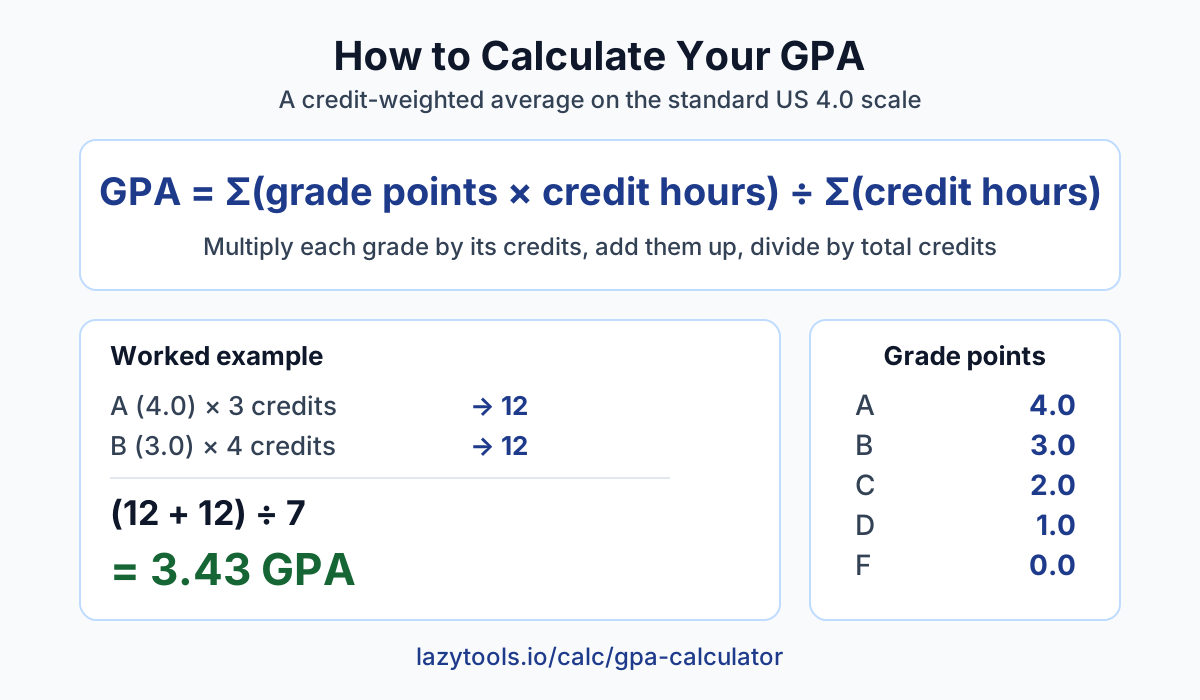
GPA is the sum of (grade points × credit hours) for every course, divided by the sum of all credit hours. The credit weighting is the part people miss, a course you spend more hours on counts proportionally more.
First, turn each letter grade into grade points using the 4.0 scale (table below). Then multiply by the course’s credits to get quality points. Add the quality points, add the credits, and divide.
Take two courses: an A (4.0) in a 3-credit class and a B (3.0) in a 4-credit class.
- Quality points: 4.0 × 3 = 12, and 3.0 × 4 = 12
- Total quality points: 12 + 12 = 24
- Total credits: 3 + 4 = 7
- GPA: 24 ÷ 7 = 3.43
A naive average of 4.0 and 3.0 would give 3.5. The real answer is lower because the B is attached to more credits, so it pulls harder. That single idea explains almost everything about how GPA behaves.
A fuller term makes the pattern clear. Here are four courses laid out as quality points:
| Course | Grade | Points | Credits | Quality points |
|---|---|---|---|---|
| Biology | A− | 3.7 | 4 | 14.8 |
| History | B+ | 3.3 | 3 | 9.9 |
| Calculus | B | 3.0 | 4 | 12.0 |
| Seminar | A | 4.0 | 1 | 4.0 |
| Total | 12 | 40.7 |
Term GPA = 40.7 ÷ 12 = 3.39. Notice the 1-credit A barely lifts the average, while the 4-credit courses dominate, exactly the credit weighting at work.
Grade points on the 4.0 scale
Grade points map letter grades to numbers so they can be averaged. Here’s the common US mapping:
| Letter | Grade points | Letter | Grade points |
|---|---|---|---|
| A | 4.0 | C | 2.0 |
| A− | 3.7 | C− | 1.7 |
| B+ | 3.3 | D+ | 1.3 |
| B | 3.0 | D | 1.0 |
| B− | 2.7 | D− | 0.7 |
| C+ | 2.3 | F | 0.0 |
Two caveats. Some schools use a plain scale with no ± steps (A = 4.0, B = 3.0, and so on). A few award A+ = 4.3, which lets a term GPA edge above 4.0 even without weighted courses. Scales genuinely vary by institution, so check your registrar’s official chart before trusting any calculator’s default.
Weighted vs unweighted GPA
An unweighted GPA caps at 4.0 and treats every class identically; a weighted GPA adds points for harder courses, so it can climb above 4.0. This is why a high-school transcript sometimes shows a 4.2 or 4.5.
The common convention is a bonus of roughly +0.5 for honors and +1.0 for AP or IB courses, applied before averaging. So an A in an AP class might count as 5.0 instead of 4.0 on a weighted scale.
Those specific bonuses are conventions, not laws, the exact amount is set by each school, and some cap the weighted maximum or weight only certain subjects. If you’re comparing your number against a class rank or an admissions threshold, confirm which scale is being used, because a weighted 4.3 and an unweighted 3.8 can describe the same transcript.
Cumulative GPA across every term
Cumulative GPA applies the same credit-weighted formula to all your courses from all terms at once. It is not the average of your term GPAs. Pour every course’s quality points into one pile, every credit into another, and divide.
This matters whenever your terms carry different credit loads. Suppose one term is a light 6 credits at a 3.0 and the next is a heavy 18 credits at a 3.8. Averaging 3.0 and 3.8 gives 3.4, but the heavier, higher term deserves more weight, the true cumulative figure lands closer to 3.6. Always re-weight by credits; never average the averages.
A related consequence: once many credits are banked, any single new grade barely moves your cumulative GPA. Early grades set the trajectory; later ones fine-tune it. That’s reassuring after one rough class and sobering when you’re hoping a final A will rescue a low average.
What grade do I need on my final?
To find the grade you need on a final, use:
needed = (target − current × (1 − weight)) ÷ weight
Here current is your grade so far, weight is the final’s fraction of the course grade, and target is the overall grade you want.
Worked example: you’re sitting at 88%, the final is worth 30% (0.30), and you want to finish with a 90%.
- 1 − weight = 1 − 0.30 = 0.70
- current × 0.70 = 88 × 0.70 = 61.6
- target − that = 90 − 61.6 = 28.4
- ÷ weight = 28.4 ÷ 0.30 = 94.67%
So you’d need about 94.67% on the final. If the formula returns a number above 100%, your target isn’t reachable with this final alone; if it returns something at or below zero, you’ve already locked in the grade. To turn a raw score like “43 of 50 correct” into the percentage this formula expects, run it through the test grade calculator first, and see the percentage guide if the “of” and ”%” steps trip you up.
Common mistakes
A few errors account for most wrong GPA numbers:
- Averaging term GPAs instead of re-weighting by credits. The average of your semester GPAs only equals your cumulative GPA when every term has identical credits. Otherwise it’s wrong. Re-apply the formula across all courses.
- Forgetting credit weighting inside a term. Treating a 1-credit lab and a 4-credit lecture as equal inflates or deflates the result. Multiply by credits every time.
- Assuming every school uses ±. If your school reports plain letters, don’t invent an A− of 3.7 that doesn’t exist on your transcript, and don’t assume A+ is 4.3 unless your school says so.
- Mixing weighted and unweighted numbers. Comparing your weighted GPA to an unweighted cutoff (or vice versa) is comparing two different scales.
- Rounding too early. Round the final GPA, not the intermediate quality points, or small errors compound.
Calculate your GPA privately
Enter your grades and credits in the GPA calculator and it applies the credit-weighted formula exactly, term GPA, cumulative GPA, and the grade you’d need on a final, without the arithmetic slips above.
Everything runs in your browser. Your grades are never uploaded, never stored on a server, and never leave your device, the calculation happens locally, so a sensitive transcript stays yours.
Frequently asked questions
How is GPA calculated?
GPA is a credit-weighted average: multiply each course's grade points by its credit hours, add those up, then divide by the total credit hours. On the standard US 4.0 scale, an A in a 3-credit class and a B in a 4-credit class give (4.0×3 + 3.0×4) ÷ (3+4) = 24 ÷ 7 = 3.43. A simple average of 4.0 and 3.0 would wrongly give 3.5, credits matter.
What grade do I need on my final?
Use needed = (target − current × (1 − weight)) ÷ weight, where weight is the final's fraction of your grade. If you have 88% going in, the final is worth 30% (0.30), and you want a 90%: (90 − 88 × 0.70) ÷ 0.30 = (90 − 61.6) ÷ 0.30 = 94.67%. A result above 100% means the target is out of reach; a negative number means you've already secured it.
What are grade points on a 4.0 scale?
The common US mapping is A = 4.0, A− = 3.7, B+ = 3.3, B = 3.0, B− = 2.7, C+ = 2.3, C = 2.0, C− = 1.7, D+ = 1.3, D = 1.0, D− = 0.7, F = 0.0. Some schools drop the ± steps and use a plain scale, and a few award A+ = 4.3. Always check your institution's official scale.
Does a bad grade ruin my GPA?
It depends on how many credits you've already banked. Early on, one grade swings your average a lot; once many credits are recorded, a single grade barely moves it. That cuts both ways, a late A also nudges the average less than an early one.
What's the difference between weighted and unweighted GPA?
An unweighted GPA caps at 4.0 and treats every course the same. A weighted GPA adds points for harder courses, commonly around +0.5 for honors and +1.0 for AP or IB, so it can exceed 4.0. The exact bonus varies by school, so confirm your school's policy before comparing numbers.
Is cumulative GPA the average of my term GPAs?
No. Cumulative GPA re-applies the credit-weighted formula across every course from every term, not the average of your per-term GPAs. Because terms can carry different credit loads, averaging the term GPAs gives the wrong answer whenever those loads differ.